
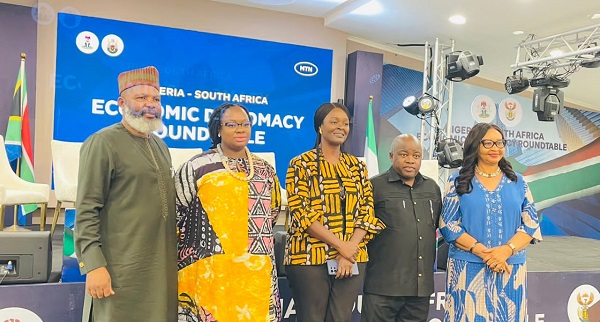
Nigerian stakeholders and South Africa The second edition of the Nigeria-South Africa Economic Diplomacy Roundtable recently held in Lagos reaffirmed the commitment to deepen economic cooperation, trade and infrastructure development.
The roundtable brought together senior government officials, diplomats and private sector leaders to advance shared priorities with an emphasis on strengthening bilateral relations and translating the dialogue into actionable economic outcomes.
In his welcome address, Onyeni Ikenna-Emeka, Chief Marketing Officer of MTN Nigeria, speaking on behalf of the Chief Executive Officer, Dr. Carl Toriola, described the roundtable as central to Africa's economic future.
“The Economic Diplomacy Roundtable is not just a corporate event; it reflects the essence of our purpose on the continent and the systems we must build to enable Africa's development. The partnership between Nigeria and South Africa must move beyond dialogue to building infrastructure, payment systems and digital platforms that make trade and investment seamless,” he said.
The Group’s Chief Sustainability and Corporate Affairs Officer, Nompilo Morafo, said the company’s 30-year presence across Africa has provided valuable insights into the economic realities and opportunities of the continent, pointing out that Nigeria and South Africa together account for almost half of Sub-Saharan Africa’s GDP, making their partnership essential to the success of AfCFTA.
“When these economies trade freely, AfCFTA becomes real. When the payments system works between Lagos and Johannesburg, financial inclusion is accelerated across the continent,” he said.
“Our true purpose is not just to provide digital and financial services, but to bring dignity, hope and opportunity to millions of Africans,” Morafo said.
Highlighting the economic importance of Lagos State, the Commissioner for Trade and Investment, Folashade Ambrose-Medebem, represented by Adeyemi Adeyinka, said Lagos accounts for about 30 per cent of Nigeria’s GDP and attracted about N4.1 trillion in investment and $1.2 billion in digital infrastructure in 2023.
Emphasizing the importance of strong bilateral cooperation, he said: “Lagos is open to partnerships that promote trade, investment and innovation, as we continue to position the state as a leading economic hub in Africa.”
Executive Secretary and Chief Executive Officer of the Nigerian Investment Promotion Commission (NIPC), Her Excellency Aisha Rimi, underlined the ongoing efforts to create a stable and enabling environment for investors.
He said: “Nigeria is committed to creating a stable and enabling environment that attracts investment, strengthens investor confidence and supports sustainable economic growth. Our focus is to ensure that investors not only come to Nigeria but are able to grow, expand and connect across African markets.”
From a South African perspective, Acting Consul General of South Africa in Lagos, His Excellency Kgothatso Zulu, highlighted the scale of opportunity between the two countries and stressed the importance of cooperation in expanding intra-African trade.
He said: “There is a significant opportunity to expand intra-African trade, and such partnerships are vital to removing barriers and strengthening economic integration. Nigeria and South Africa have a responsibility to lead by example in building stronger, more connected African economies.”
Emphasizing the need for concrete results, Kelvin Phum, Director of Africa Bilateral Economic Relations at the South African Department of Trade, Industry and Competitiveness, stressed the enduring importance of the Nigeria-South Africa partnership.
“The South Africa-Nigeria partnership is of enduring political and economic importance not only for both our countries but for the African continent. The focus now must be on implementation, translating policy commitments into real trade, investment and infrastructure outcomes.”
Discussions at the roundtable highlighted progress under the AfCFTA, ongoing policy reforms and the urgent need to strengthen infrastructure systems, improve trade corridors and remove barriers affecting cross-border trade.
Stakeholders agreed that stronger collaboration between Nigeria and South Africa will be key to unlocking industrial growth, investment flows and regional value chains, while committing to translate the discussions into actionable outcomes that support Africa’s economic integration agenda.