
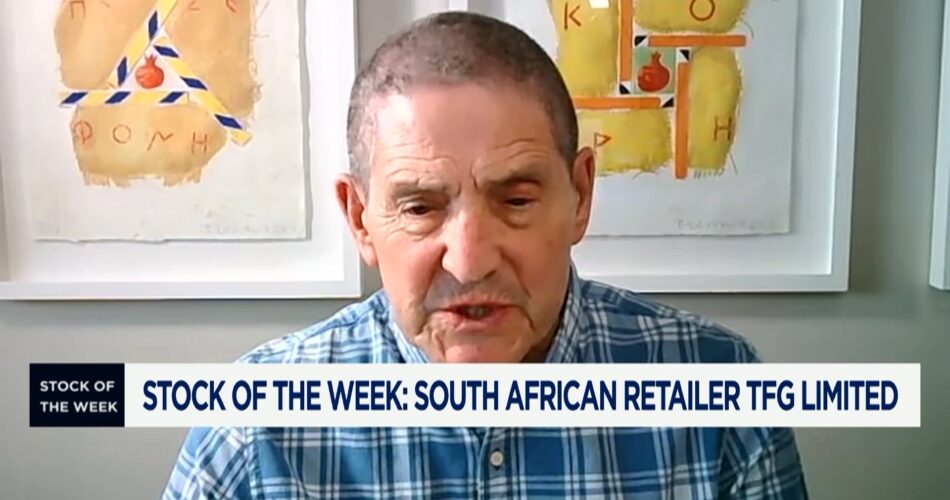
Foschini Group, one of South Africa's best-known fashion and lifestyle retailers, is facing increasing pressure after warning that earnings per share for FY26 could fall by as much as 40%, a sharp sign that investors and analysts say reflects both company-specific challenges and a worsening consumer backdrop.
The warning, made in a trading update released after market close, triggered a fresh selloff in the stock and reignited concerns about whether TFG's expansion strategy, particularly offshore, has weakened what many still consider a fundamentally strong retail business.
Speaking on CNBC Africa's Stock of the Week, David Shapiro, chief global equity strategist at Sisyphean Wealth partner OO 1890, said the update was like a set of “alarm bells” for the company, even as he stressed that TFG remains a quality retailer with recognizable brands and a strong in-store proposition.
“It's a really good company,” Shapiro said, pointing to brands like @Home, Sportscene and TotalSports. “I can't fault them for the quality of their product, but their acquisitions have gone wrong, and you can't ignore the environment either.”
The retailer's difficulties follow a period in which management sought to position TFG as a more modern, technology-enabled growth story. That strategy had raised expectations among investors, especially after the company's capital markets infusion late last year. But the latest guidance has reignited questions about whether implementation matches those ambitions.
Shapiro said there was “very good confidence” in management and CEO Anthony Thunstrom's strategic vision, which also included efforts to strengthen vertical integration and expand the homeware business. Instead, disappointment has grown as many parts of the group have failed to perform as expected.
A large part of the problem appears to be offshore. Shapiro highlighted losses and writedowns associated with businesses outside South Africa, including UK series Phase Eight, the recent acquisition of White Stuff and operations in Australia. While the White Stuff was said to be helpful to some extent, the broader international portfolio has weighed on performance.
This pattern is familiar in the South African retail sector, where companies seeking growth outside the sluggish domestic economy often struggle in more competitive overseas markets. Australia in particular has proven difficult for South African retailers, with the history of Woolworths often cited as a cautionary tale.
“Local companies are looking for growth as the South African economy is under pressure,” Shapiro said. “They don't want to give up on development, so they start going out and looking, and it's difficult.”
Nevertheless, TFG pressures are not limited to offshore operations. The domestic consumer environment is also deteriorating, with households facing rising cost of living and retailers increasing competition for the wary customer. Shapiro warned that higher oil prices, geopolitical uncertainty and inflationary pressures could further reduce discretionary spending.
With oil prices rising well above levels seen a few months ago, he said the impact will be felt not only through direct fuel costs, but across the supply chain, from imports to logistics to broader operating expenses. This, in turn, risks reducing both retail margins and buyer demand.
“They have to pay attention to their wallet,” he said of consumers, suggesting that more families might shift spending toward essentials and lower-priced retailers like Boxer and Shoprite.
At the same time, TFG faces stiff competition from global online fast-fashion players including Shein and Teemu, who have expanded their presence in South Africa with aggressively priced offerings. Shapiro said these platforms are making a meaningful impact in a market where consumers are highly price-sensitive.
Fashion retail is also inherently volatile, and TFG is not immune to inventory and markdown risks when product categories miss the mark. Shapiro said forced discounting and sales clearances have added pressure to an already competitive segment.
The pain has been reflected in the share price. According to Shapiro, TFG stock is down about 64% since the beginning of 2025, and investors who bought shares five years ago will be sitting on a loss of about 40% even after accounting for dividends. He said the company's market capitalization had now fallen to about R19 billion, leaving it among the smaller listed retailers on the JSE.
Despite that decline, some institutional investors are taking a long-term view. Shapiro pointed to Old Mutual's move to increase its stake in TFG to 5.11%, suggesting some investors may see value emerging after the selloff. Still, he cautioned against trying to call a bottom too early.
“You don't need to rush into these things,” he said. “When you've got an environment like this that hasn't stabilized, you don't need to try to find the bottom.”
For now, he believes there could still be more pain to come, especially given TFG's own warning that input costs are likely to rise due to geopolitical uncertainty and consumers remaining cautious.
However, there is some scope for flexibility. Despite a relatively small base, beauty has emerged as one of the group's better performing categories, with sales growth of around 24%. Shapiro linked that trend to the so-called “lipstick factor,” the idea that consumers continue to spend on affordable beauty items even in tough economic periods.
This may provide some relief, but is unlikely to offset the broad-based weakness in the rest of the portfolio.
The big challenge for TFG now is whether it can restore confidence in its strategy while recovering from a deeply uncertain consumer and cost environment. For investors, the stock may eventually offer recovery potential, but the latest warning suggests the case for a turnaround remains early and risky.
As Shapiro said, the pressure on TFG is “not a reflection on management” alone, but on a business caught between strategic missteps and an unforgiving retail landscape.