
The BRICS Business Council of South Africa is stepping up efforts to transform the country's membership into more concrete trade, investment and financing opportunities, as business leaders and policymakers respond to the rapidly changing global geopolitical and trade environment.
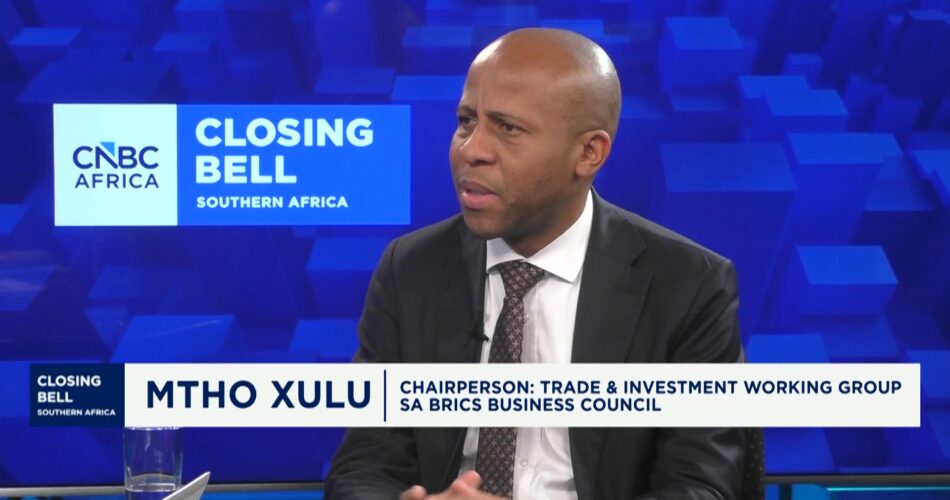
Speaking to CNBC Africa, Mtho Zulu, chair of the trade and investment working group of the BRICS Business Council South Africa chapter, said the latest round of consultations with the private sector aims to formulate a clear South African position ahead of the next BRICS summit in India.
Zulu said the discussions were triggered by growing changes in global trade dynamics, including tariff tensions, policy uncertainty and broader rethinking of supply chains and market access. Against that backdrop, he said BRICS is being seen as an important alternative forum for South Africa to diversify its markets and deepen economic cooperation.
“The most important thing that really started this conversation is the developments in geopolitics at the global level,” Zulu said, noting that there is growing recognition that global trade is going through a reset. In response, the BRICS Business Council in South Africa has launched a series of consultations with business stakeholders, designed to ensure that the country's participation in the grouping goes beyond rhetoric and delivers concrete results.
According to Zulu, the immediate objective is to prepare a country position that can be shared with the government and ultimately presented at the India summit. This process reflects an effort to align private sector priorities with South Africa's official participation in BRICS, while also ensuring that business voices shape the agenda.
A key topic of consultation is whether South Africa is making adequate use of its membership in BRICS. Zulu acknowledged long-standing concerns over the trade deficit with key BRICS partners and the limited range of products South Africa exports to those markets. For business leaders, the challenge is not only to increase volumes but to improve the value proposition of South African exports.
This means greater focus on industrialization, manufacturing and value addition. Zulu said manufacturers were specifically targeted in the latest consultations because one of the central questions is whether South Africa is exporting enough value-added goods to BRICS markets, rather than relying too heavily on a limited basket of products.
In addition to manufacturing, the Partnership also prioritized ICT and digitalization, reflecting the growing role of technology in reducing barriers to trade and making cross-border commerce more efficient. Financial services were another main pillar of the meeting, with a particular focus on BRICS payment systems, local currency trading and new digital transaction instruments.
Zulu described the financial architecture debate as one of the most complex areas under discussion within BRICS. Acknowledging that issues such as monetary policy alignment and regulatory coherence ultimately rest with finance ministers and central bank governors, he said business was actively exploring practical opportunities that could make doing business easier and more flexible.
Ideas under consideration include the expanded use of local currencies in trade between BRICS countries, with the aim of reducing the risk of volatility in traditional reserve currencies and limiting the impact of external fiscal shocks. However, Zulu stressed that negotiations are not just about replacing one system with another.
Rather, he said, BRICS countries are also looking at innovations in payments technology that can help emerging markets conduct transactions more securely and efficiently. As digital payments are rapidly reshaping global commerce, the bloc sees scope for creating systems that are better suited to the realities of developing economies, provided regulators are also involved in the process.
Zulu said South Africa's approach towards BRICS should also be based on a realistic assessment of its economic situation. As a relatively small economy compared to some of the larger members of the bloc, South Africa needs to identify where it can be most competitive, where it can add value and how it can fully benefit from the partnership without expecting the trade balance to equalize overnight.
At the same time, BRICS expansion is opening up broader strategic opportunities for South Africa. With Egypt and Ethiopia also now part of the grouping on the African continent, Zulu said there is an opportunity to strengthen Africa's collective voice within BRICS and better position the continent in trade, investment and development conversations.
He also pointed to the importance of engaging with new members and partners such as the UAE and Indonesia, both of which represent strategically important economies in the emerging BRICS+ landscape. For South Africa, that broader network can help unlock new investment corridors and supply chain relationships if approached with a coherent national strategy.
Nevertheless, Zulu made clear that trade alone cannot overcome the obstacles to deeper integration. Political support is essential, particularly in pursuing regulatory cooperation needed to remove non-tariff barriers and facilitate smooth trade and payments systems. He said that the “nerve center” of BRICS remains its Heads of State, with the work of the Business Council ultimately aimed at informing decisions at the highest political level.
South Africa is receiving strong support from the government in its BRICS participation, he said. This matters not only for the current summit cycle but also for future planning, with the BRICS summit scheduled to return to South Africa in 2028. Zulu indicated that preparations for that leadership role would begin effectively next year, as stakeholders begin to shape the themes and priorities that could define South Africa's next presidency.
In the near term, the BRICS Business Council plans to broaden and deepen its domestic reach. Zulu said the organization has agreed on a series of further activities to “domesticate” the BRICS agenda, which he argues can often feel too distant from the everyday realities of South African entrepreneurs.
The council's nine working groups covering sectors ranging from energy and skills to trade, investment, aviation and manufacturing are expected to launch similar consultations across the country. The intention is to create a sustainable platform for engagement, including regional outreach, as well as strengthen coordination with Egypt and Ethiopia to build a more integrated African position within BRICS.
For South Africa, the message from the latest consultations is clearer: in a world of geopolitical fragmentation, rising economic nationalism and changing trade alliances, BRICS+ is being positioned not only as a diplomatic platform, but as a practical vehicle for market diversification, financial innovation and industrial expansion. The challenge now will be to translate those ambitions into measurable business benefits.