
Influencers, content creators and even legislators have urged the South African Revenue Service (SARS) to impose a fair tax on billion-dollar tech giants before considering a tax on social media influencers and content creators.
A parliamentary roundtable on podcasters was held this week and SARS recently commented about the need to develop a system to tax highly paid social media influencers. These have focused on proposals to tax content creators.
According to the Independent Communications Authority of South Africa (Icasa), telecommunications operators generated revenues of R159.3 billion in 2024 from customers using their services to access social media platforms.
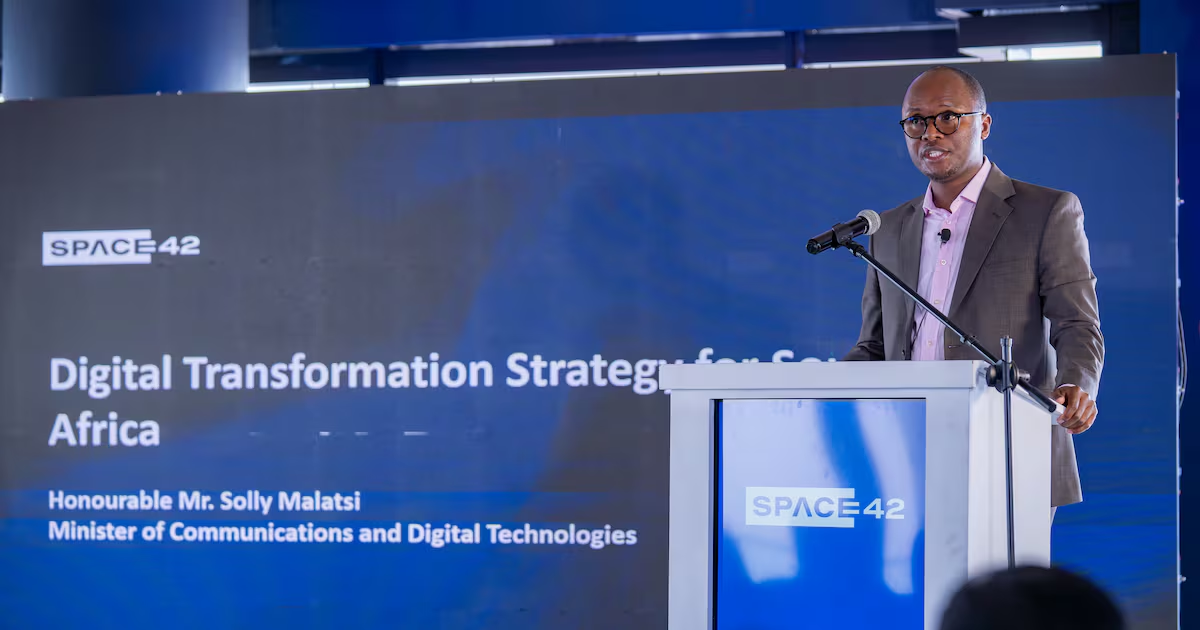
Answering questions in the National Assembly this week, Communications and Digital Technology Minister Solly Malatsi said South Africa was busy finding a balanced approach to regulating over-the-top (OTT) media platforms, as they offered “very attractive” measures that influencers use to distribute their content.
South Africa has not finalized the best approach to maximize the two things that are coming to the fore all the time, which is the best taxation distribution that will enable more investment into the country which will help in the uptake of more local productions coming forward and secondly we will continue to ensure that we remain the destination for these OTTs to expand their investment.
— Solly Malatsi, Minister of Communications and Digital Technology
“South Africa has not finalized the best approach to maximize the two things that are coming up all the time, which is the best taxation distribution that will enable more investment into the country that will help the uptake of more local production going forward, and secondly we will continue to ensure that we remain the destination for these OTTs to expand their investment,” he said.
Asked about the need to regulate podcasters to curb misinformation and disinformation, Malatsi said the Film and Publications Board (FPB) needs to be strengthened through increased budgetary allocations to boost enforcement of safeguards against misinformation.
“To be clear, while acknowledging the enormity of the issue we are dealing with, the FPB's interventions, while effective, are falling short as the reality is that we are seeing an increase in the spread of disinformation and misinformation.”
Chairman of the Portfolio Committee on Communications and Digital Technologies, Khusela Sangoni DikoSaid that the Committee appreciated that content creators in South Africa are a thriving business that deserves a modern legislative system and government support.
“This means that, as part of this, we need to look at how we professionalize this sector to protect it. The discussion is not just about content, but about platforms and their responsibility.
“We understand SARS' thinking in this regard because they are being recognized as businesses, but we want to have a more comprehensive conversation… We need to understand the monetization side of it… and how they impact podcasters and so on.”
Before South Africa talks about taxes or licensing systems, industry stakeholders have the opportunity to provide input and insight, he said. The Committee looks forward to dialogue with SARS and other government departments on this matter.
Meanwhile, Malatsi released a draft white paper on audio and audiovisual media services and online security for final written comment in 2025. Its goal is to “create a safe, inclusive and competitive digital media ecosystem that reflects South Africa's cultural diversity and democratic values, while aligning with international best practices”.
SARS Commissioner Edward Kieswetter told the Sunday Times in the week of his 2026 budget speech that the methods and means of extracting tax revenue from wealthy social media influencers are a puzzle that various countries are working on, including the Organization for Economic Co-operation and Development (OECD).
“In a way, we are in uncharted territory, but in many cases, we are struggling side by side. We work closely with our OECD peers to pull our weight… If you think about the digital marketing sector, their business models are changing from billboards and TV ads to social media.
“If you consider the digital marketing, advertising marketing size of the business…let's say it's R30bn, at least half of that has moved to social media. So that's the first. But they're formalised, they're already registered, so it's not like nothing of them is captured.
“Then if you add to this individuals, not formal digital marketing agencies, who have entered that space – these would be influencers who are on TikTok, on YouTube, who gain followers, and then monetize this following… We are saying, look, all types of income, no matter how you earn it, should be taxed. If you are earning more than the limit, from any activity, you are subject to paying tax.”
Kieswetter said SARS is updating the nexus that determines the right to tax from a company's physical presence to its market presence. If a company is present in a market, it has to pay taxes in that market, even if it has an office there.
“Some of the big policy issues are how tax policy keeps up with the digitalization of economies. In the good old days, (there was) the principle that determined the right to tax. Now, the rights to tax are sovereign rights. The rights to tax are deeply sovereign. But the way the rights to tax were determined was based on physical presence.
Any consideration of new taxation measures must take into account the structure of the producer economy in South Africa. A very small percentage of creators generate significant business income, while the vast majority are either in the early stages or generate minimal revenue.
— Jonathan Warnke, South African Podcasters Guild MD
“But that was at a time when a factory was a physical location, (or) a store was a physical location. Now with the proliferation of e-commerce, digital services, if you're buying a book from a Kindle, it's not a physical book… Netflix (and) Google services… are services that are provided within one jurisdiction but manufactured in another, where the head office is.”
William Bird, director of Media Monitoring Africa, said that in the UK, Amazon reportedly paid one pound in tax relative to its huge market capitalization of more than $2-trillion, adding that tech companies that serve as platforms for influencers and content creators receive larger revenues without paying proportionate tax.
“In an ideal world, which is not the case, you would say if you earn your income as an influencer, you should be paying taxes on it… But it's not an ideal world, and I think… it's incredibly difficult to track. There are a lot of steps you have to take to do that. But I think before that, we need to know from companies how much tax they're actually paying.”
South African Podcasters Guild (SAPG) MD Jonathan Warnke said the guild's understanding is that existing tax law already applies to income earned by content creators, including revenue from brand partnerships, advertising and sponsorships.
“From that perspective, creators looking to generate meaningful income should contribute within already existing frameworks. However, the majority of podcasters and content creators in South Africa earn little or no income from their work or treat it as a secondary income source.”
Any new policy will need to carefully differentiate between full-time professional creators and hobbyists or early-stage creators.
“Any consideration of new taxation measures must take into account the structure of the creator economy in South Africa. A very small percentage of creators generate significant business income, while the vast majority are either early stage or earn minimal revenue.”
Existing tax structures already provide mechanisms for taxing income from brand deals, advertising and sponsorships. He said clarity, enforcement and education could be more effective than introducing entirely new categories of taxation.
Business Times