
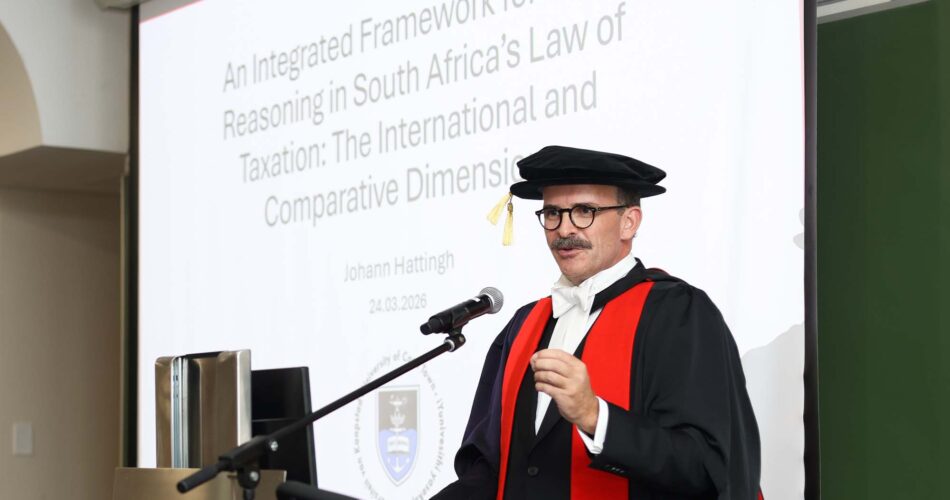
“There is a need to seek clarity about the guiding principles for law reform and to develop legal principles for its application, which is essential to strengthen reform discussions of the international tax regime. This, as we grapple with uncertainty and rapid social change brought about by new technologies.”
So said Professor Johan Hattingh as he delivered his inaugural lecture at the University of Cape Town (UCT) on 24 March. The lecture examined the international and comparative tax law dimensions of an integrated framework for statutory and treaty interpretation shaped by landmark decisions. Natal Joint Municipal Pension Fund v Endumeni Municipality (2012).
The case, which was heard in the Supreme Court of Appeal (SCA), is a decision that played an important role in advancing a unitary approach to legal reasoning in South African law, particularly in disputes over tax law and the interpretation of treaties.
“I want to focus on something that is not often done and that is a comparative and international dimension to the legal method of interpretation that this case has given strength to,” Professor Hetting said. “What is envisioned is a unitary process of reasoning. This is important because it is not a hierarchy of rules. In this unit, you integrate the text, the context, the purpose of the legal rule, and the background of the circumstances. The first observation about the decision is that it gives lawyers an injunction to follow that reasoning.”
Hettingh is a scholar of international tax law and the history of taxation. He is Professor of Commercial Law at UCT's Faculty of Law and an advocate of the High Court of South Africa.
“I think in South African case law we have begun to grapple with the complexities of purposive readings of tax law instruments.”
He examined three characteristics of the unitary method of legal reasoning. First, the need to recover legislative meaning through historically based reasoning. How serious are we in taking this injunction? He illustrated this in the context of comparative legal work done regarding a foundational case for income tax jurisdiction, namely De Beers v. Howe (1906). Secondly, he considered the need to connect the law and the purpose of treaties through reflection on differing judicial approaches in South Africa and elsewhere.
Third, they examined some of the limitations of the unitary method in the Endumeni decision, such as the narrow scope of adapting existing tax law to rapidly evolving new social situations, including the digitalization of economic activity and the mobility of people.
South Africa's history with the Income Tax Act shows that from time to time large doses of foreign legislation served as inspiration, Hattingh said, and often provisions were copied verbatim. “To truly understand the meaning of a borrowed law, one needs to understand the moment of its creation. Therefore, the interpreter is always called upon to engage with comparative legal situations in the original legal system.”
clear objective
Hattingh continued: “The place of comparative law development within the Endumene approach has not received much attention. I realized this in 2018 after doing archival and comparative work for a book about it.” Historical cases in revenue law. I had the privilege of working with Dr. John Avery Jones, a retired United Kingdom judge, on the 1906 decision of the House of Lords in the case of De Beers Consolidated Mines Ltd. v. Howe (1906) AC 455.
The decision in the De Beers case has become the foundation of the statutory test for corporate tax jurisdiction in many countries, including South Africa. South Africa, like many other countries, imported the statutory test for corporate tax residency from English tax law, for which De Beers v Howe laid the foundation.
Hetting was part of the group that researched the background of the case. “Some of the findings were that the decision was based on extremely imperfect facts; that the circumstances of the company and its corporate governance were so unique that it could not be easily replicated and therefore should be set aside in future disputes; that subsequent case law reiterated the decision without recognizing historical inconsistencies.”
“This whole episode about De Beers shows both the benefits and challenges to the endowment reasoning method. Drawing meaning from historical circumstances again strengthens our understanding of the historical elements of current tax law,” Hattingh said.
“Endumeni requires the interpreter to consider the language used in the light of the 'apparent purpose' to which it is directed. This is a very deliberate qualification of purpose; it is not the subjectively held purpose of the person who drafted the legal provision. It is objective as it appears objectively to the reader of the text.
“Using purposive readings of tax laws, unstated requirements and qualifications, risks non-compliance with constitutional values and particularly law-making processes. I think that in South African case law we have only begun to grapple with the complexities of purposive readings of tax law instruments.”
Examining the limitations, Hattingh said: “The basic problem is that no legal draftsperson can predict the future, and so it is impossible to think through all the possible questions about the meaning of written law that will arise when new and unique factual circumstances arise. The question of whether tax law in South Africa needs to be interpreted in a static or dynamic manner is largely managed in our domestic law through a robust system of annual law changes (which The solution is for the government to reform the law; it is not for the courts and practitioners to do so through interpretation that is not contained in the written law.”