
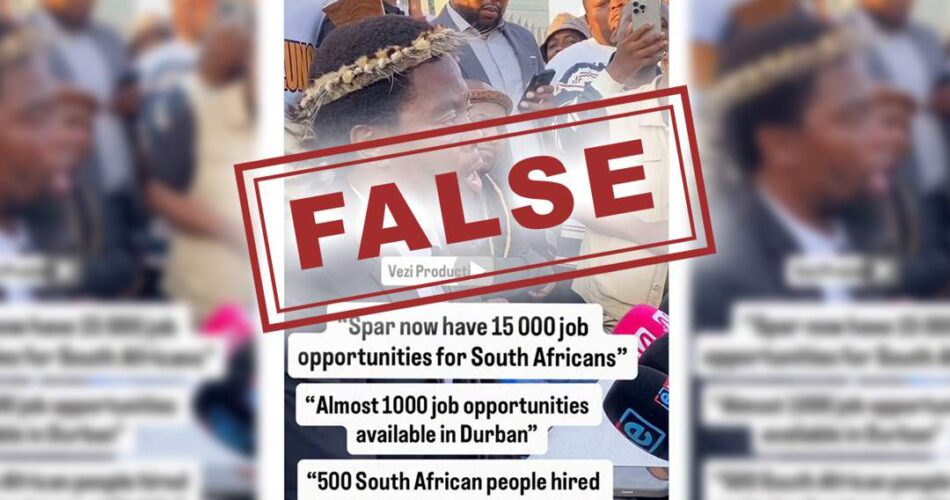
- SPAR has rejected claims that by March it had launched a recruitment drive for 15,000 jobs.
- The anti-immigrant group and its followers are spreading similar claims around delivery work, restaurants, factories, domestic work and informal trade.
- These claims are made without any evidence and ignore immigrants who can legally work in South Africa.
SPAR has rejected a viral claim that the march and the March protests helped open up 15,000 jobs for South Africans at the supermarket group.
The claim is part of a broader pattern of posts crediting the anti-immigrant movement for creating jobs in supermarkets, delivery work, restaurants, factories and domestic work.
The most prominent versions of the claim appeared in videos and posts shared on Facebook, Instagram and Twitter after March, when activists targeted businesses over their employment of foreigners.
In a video, Nkosikhona “Phakelumthakathi” Ndabandaba says that, as a result of the movement, SPAR now has 15,000 job opportunities for South Africans, about 1,000 in Durban, and 500 South Africans have been hired to replace foreigners in Umbilo.
But SPAR Group has called these claims false.
“SPAR Group South Africa is aware of social media posts falsely claiming that SPAR has launched a recruitment drive for 15,000 jobs, including misleading claims about the reasons these positions are allegedly not available,” the company said in response to News 24 questions.
The company added:
We categorically reject these claims. SPAR South Africa is not advertising 15,000 jobs, and no such recruitment initiative exists.
“These false and misleading posts are being disseminated without authorization and do not reflect any communication or initiative of SPAR Group South Africa.”
SPAR said recruitment remains a normal part of its business, and occurs through established processes.
The company said, “As one of South Africa's largest employers, SPAR creates employment opportunities across its corporate operations, distribution centers and independently owned SPAR stores. Recruitment is an ongoing part of the operation of a business of our scale through established recruitment processes.”
It also rejected the claim's implicit suggestion that workers could be fired or hired based on nationality.
“SPAR is committed to fair, lawful and responsible employment practices in accordance with South African labor law. Employment decisions are based on the requirements of the role, relevant skills, experience and legal eligibility to work in South Africa. We employ people who are legally entitled to work in the country, regardless of their nationality. We are committed to maintaining safe, respectful and inclusive workplaces, and do not tolerate discrimination of any kind.”
The company said that legitimate job opportunities were advertised through SPAR's official channels or, where applicable, by independently owned SPAR stores through their own recruitment processes.
Read | Fake Home Affairs reward poster targets foreigners in South Africa
The unfounded SPAR claim is the clearest example of the widespread disinformation pattern surrounding the protests, which often circulates in an ecosystem where followers do not care to verify claimed statements as facts.
Similar posts and videos claim, without evidence, that pressure from the movement has opened up jobs in delivery work, restaurants, factories and other sectors. Some posts present the fear, shop closures and departure of migrant workers as evidence that work has suddenly become available to South Africans.
The claim is also based on the false premise that foreign workers are illegal by default and removing them from workplaces creates verified jobs for South Africans.
Some marchers and march leaders have said that they are only targeting undocumented foreign nationals. But South African law already prohibits employers from hiring undocumented foreign nationals, making it unlikely that reputable businesses and organizations will risk openly hiring people without the correct papers.
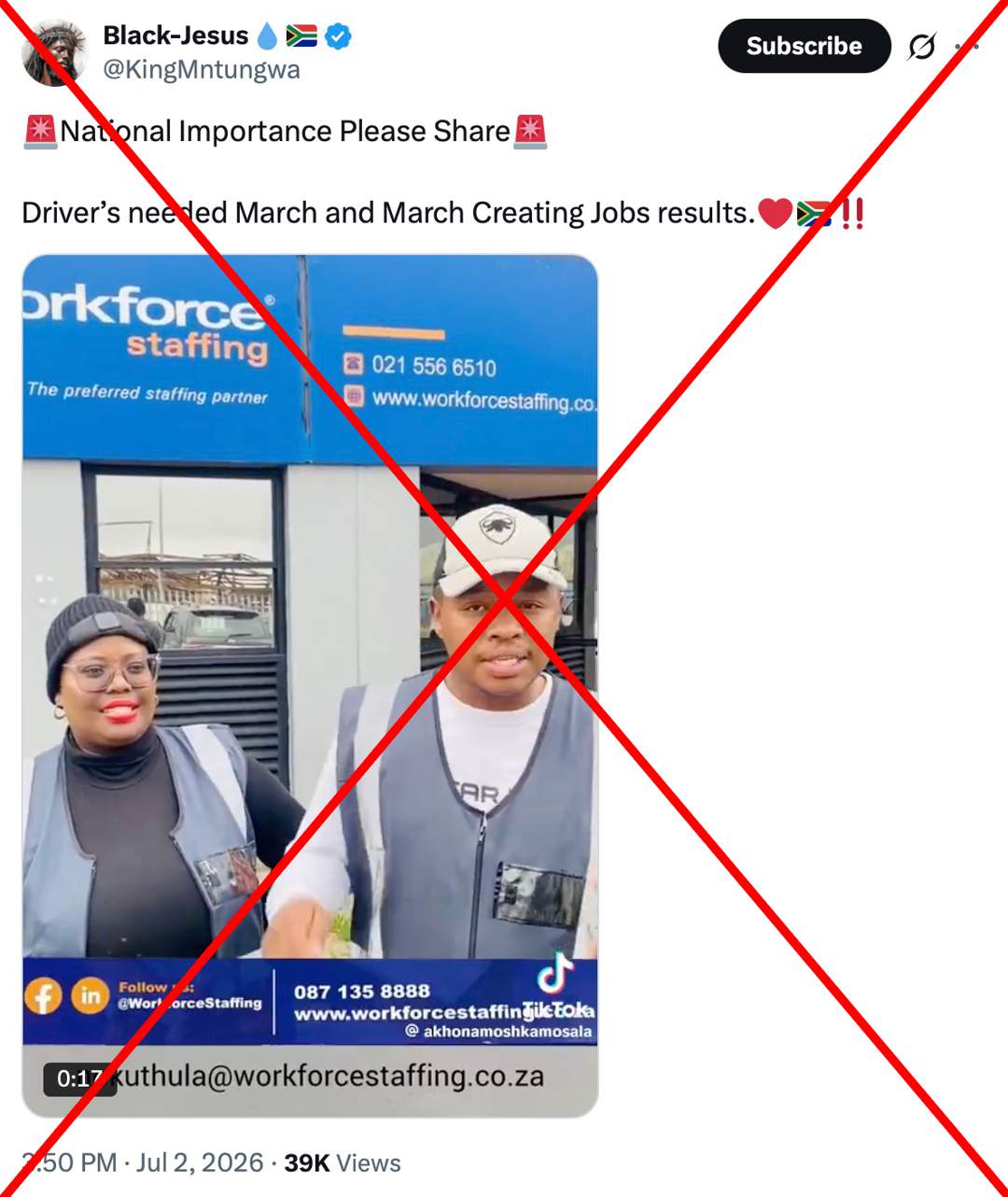
Other bold claims made on social media are unsubstantiated with evidence.
Employment and Labor Department It is said that the Employment Services Act and the Immigration Act prevent an employer from employing a foreign national before he presents an applicable and valid work visa issued by the Department of Home Affairs.
For example, Zimbabwean exemption permit holders are legally documented under the current extension. In April, home department Said there was “no change in policy” on ZEP holders and existing permits would remain valid until May 29, 2027.
refugees may also have the right to work. A recognized refugee with a Section 24 permit has the right to seek employment in South Africa. Asylum seekers with Section 22 documents do not have automatic permission to work under the amended Refugee Act, meaning their personal documents and conditions must be checked.
SweepSouth, a platform used by home workers and gardeners, makes a similar difference to its worker application process. in an interview on cape talkCEO Laurandi Kriel said 55% of its service providers are Zimbabweans. Its application process clarifies that non-South African applicants must have a “work permit, refugee ID (legal document that allows you to work in South Africa), or residency”.
Employment equity rules add another layer. Foreign nationals do not qualify as members of specified groups. Employers may include foreign nationals in the report, but Employment and Labor Department Says they cannot be used as members of specified groups or as a basis for setting numerical targets.
Employers, particularly those required to comply with employment equity regulations, face legal restrictions regarding undocumented workers and employment equity reporting. Those restrictions do not deny every foreign worker, undocumented or legally documented immigrants, the right to work.
Read | Anti-immigrant account shares fake Lamola grants travel claim lifted from a 'satire' site
Some marchers and march protesters have largely blamed immigrants for taking away jobs, increasing crime and putting a strain on public services, although experts refute those claims. make migrants about 5.1% South Africa's share of the population is understated by global standards.
Researchers have also challenged the jobs claim.
Wise Educators Justin Visagie and Ruth Castell-Branco wrote Many South Africans believe that immigrants take jobs from people born in the country, but “public perceptions do not always correspond to reality”.
His research shows that if all foreigners' jobs were somehow handed over to unemployed South Africans, the unemployment rate would drop six percentage points, from 43.6% to 37.6%.
Some Facebook pages sharing the SPAR claim have also revealed a willingness to use the march and controversial xenophobic posts to generate their own passive income. Many have led posts about the protests to attract followers and paid subscribers, including subscriber badges for a monthly fee.

Many people are using claims to increase subscribers and engagement to generate passive income from social media pages.
For now, the central facts are clear. SPAR has rejected the claim of 15,000 jobs, saying no such recruitment initiative exists, and similar claims of job openings in other sectors as a result of the March and March protests are not supported by verified employer declarations.
Instead the posts appear to be part of a broader disinformation pattern surrounding the march and the march, where organizers and followers turn anti-immigrant pressure into completely unsubstantiated “accomplishments” while treating legally documented foreign workers as if they have no right to work in South Africa.
*Facts matter at News24. This article has been produced by News24 Fact Check Desk and supported by Truth First. If there's something you want us to investigate, expose or highlight, send an email to our desk at debunk@news24.com.