
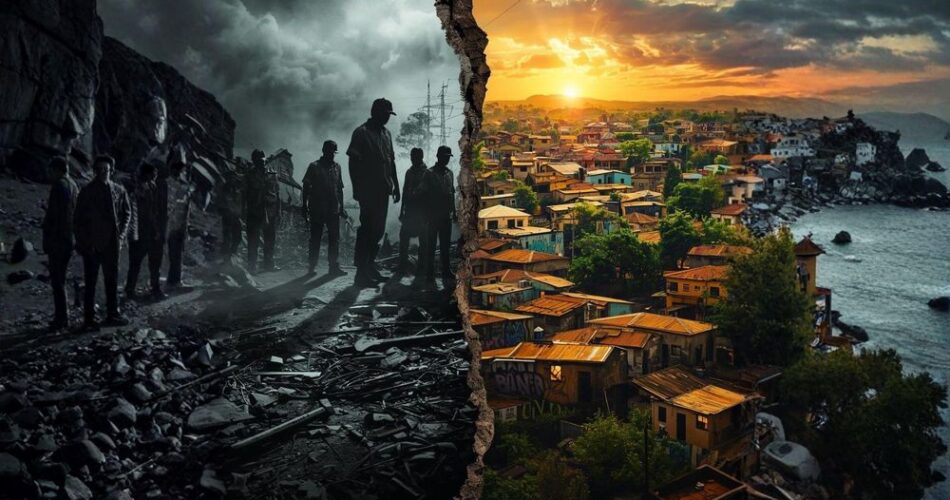

South Africa no longer faces crime as a social evil. It is confronting crime as a competitive system of governance.
Throughout the country, particularly in urban economic centers and vulnerable communities, criminal networks have established themselves not only as law breakers, but also as power brokers. They determine who can manufacture, who can trade, who can transport goods. They collect “taxes” through extortion. They enforce compliance through violence. By doing so, they not only weaken the state; They repeat it.
This is the rise of a parallel state.
The danger lies not only in the visibility of the crime, but also in its normalization. When extortion becomes a regular cost of doing business, when infrastructure projects are negotiated with syndicates rather than secured by law enforcement, and when communities turn to informal power structures for order, the authority of the democratic state begins to diminish in practice, even if it remains intact in theory.
What makes this reality particularly damaging is that it did not arise in a legal vacuum.
South Africa has one of the strongest legislative instruments to deal with this phenomenon: Organized Crime Prevention Act (POCA). Designed to destroy criminal enterprises at their core, POCA enables the state to move beyond arresting individuals and instead target entire networks; Seizing assets, disrupting financial flows, and disconnecting organized crime from its economic life.
On paper, it's a formidable weapon. In practice, it has been underutilized, inconsistently implemented, and often implemented too late.
Organized crime flourishes because it is profitable. Extortion rackets, illegal procurement schemes and infrastructure sabotage are not random acts; They are structured economic activities. The logic is simple: as long as the benefits outweigh the risks, these systems will continue to expand. 5% chance of getting caught. 5% chance of being convicted. POCA was intended to reverse that equation. Early, aggressive use of asset confiscation and enterprise prosecution could have made criminality economically unsustainable before it could metastasize. That moment was missed.
Today, the cost of that failure can be measured; And shocking. Conservative estimates suggest that crime, corruption and illicit financial flows drain between R500 billion and R1 trillion from the South African economy each year. That is not a leakage. That is a parallel budget. One that competes with, and in some scenarios even surpasses, the state's ability to provide services. Consider the following to understand scale:
The cost of crime versus the country that can make it
| Social class | Estimated Annual Cost (ZAR) | What could it fund instead? | Impact on the real world |
| Corruption in public procurement and the consequences of state capture | R150-R300 billion | Build ~2,000-4,000 schools | Eliminate overcrowded classrooms; Improving outcomes for millions of learners |
| Organized crime and extortion | R50–R100 billion | Fund ~1-2 million housing units | Dramatically reduce informal settlements and housing backlog |
| Violent Crime (Security, Lost Productivity, Health Care) | R200-R400 billion | Employ ~1-2 million public employees | reduce unemployment; Strengthen policing, healthcare and education |
| Illegal financial flows and tax evasion | R100–R250 billion | significantly expand social grants | immediate poverty relief; Hunger and inequality reduced |
| Infrastructure theft and sabotage | R20–R50 billion | Restore rail and subsidize transportation | low commuting costs; improving economic access |
Even partial recovery of these losses would be transformative. It can reshape the social contract. Instead, those resources are captured and recycled into the criminal ecosystem. They further encourage corruption, strengthen patronage networks, and strengthen the same structures that weaken the state. The result is a complex crisis: the more crime pays, the more it grows; The more it grows, the more difficult it becomes to destroy.
This is why the present moment cannot be understood merely as a failure of policing. This is a failure of enforcement strategy, institutional capacity and political will. Especially when politicians and high level officials are used to promote crime.
Laws like POCA are only as effective as the institutions that enforce them. Over time, South Africa's investigative and prosecution capabilities have been eroded due to a lack of competent staff, governance failures and, at times, political interference. Complex financial crimes require skilled forensic investigators, coordinated intelligence and prosecutorial persistence. Where these are absent, even the strongest legal framework falters.
Coordination is equally important. Organized crime operates in a variety of sectors; Manufacturing, transportation, procurement and beyond, yet the state response is often fragmented. Without unified action across law enforcement, intelligence and regulatory bodies, syndicates easily exploit institutional gaps.
But there is an even deeper, more uncomfortable truth. In some cases, criminal networks have become entangled in local political and economic structures, blurring the line between governance and illegality. This creates a dangerous balance in which crime is acknowledged but not dealt with decisively. To break that balance requires more than rhetoric. It calls for a shift from reactive policing to proactive economic disruption. The state must reassert its authority not only by arresting criminals but also by destroying the financial systems that sustain them. This means increasing the use of POCA to aggressively pursue asset confiscation, targeting entire criminal enterprises rather than individual actors, and ensuring that seized resources are redirected for public benefit.
It also means rebuilding institutional capacity; Investing in skills, protecting freedoms and restoring credibility. High-profile, successful prosecutions that dismantle major syndicates would send a powerful signal: Crime in South Africa is no longer a low-risk, high-reward enterprise.
The stakes are not abstract. They appear in stalled infrastructure projects, in businesses forced to close under extortionate pressure, in communities where security is negotiated rather than guaranteed. They are reflected in lost jobs, poor services and deepening inequality. They come to light when witnesses to a crime nearly order a murder.
If current trends continue, South Africa risks establishing a dual system of governance: a formal democratic state that co-exists with an informal criminal system. This is a path toward long-term instability and diminished sovereignty. But decline is not inevitable.
Legal tools exist. The economic issue is tremendous. Social imperative is urgent. What remains uncertain is whether the state can resolve to act decisively; Not only to manage crime, but also to destroy the parallel systems that now compete with it. Because in the end, the true cost of crime and corruption is not measured only in billions of rands lost. It is measured in a country that could have been built. And there was no more.
* Shabodian Rumane is the Board Chairman of Muslim Views Publications, a founding member of the Salt River Heritage Society and a Trustee of the SA Foundation for Islamic Art.
**The views expressed do not necessarily reflect the views of IOL or Independent Media.