
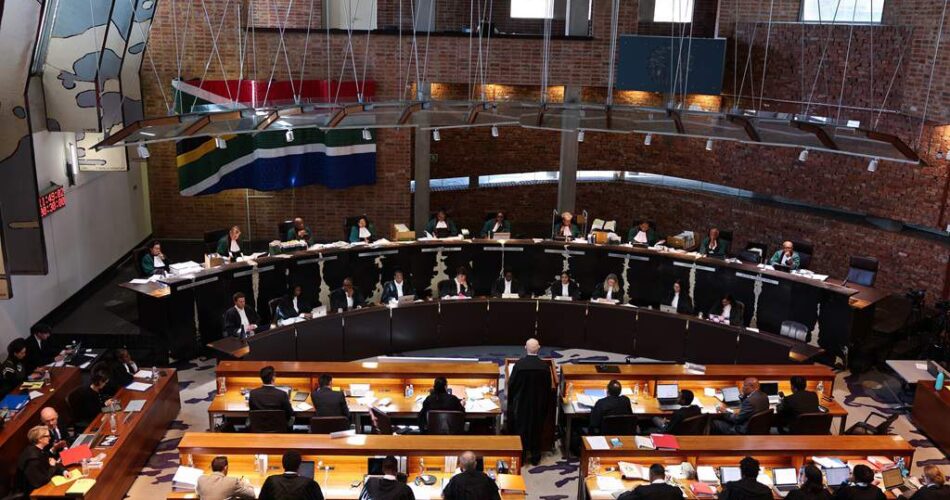
Directives emerging from the SA Human Rights Commission's investigation are not legally binding, the Constitutional Court has ruled.
Luba Lesol/Gallo Images
- The Constitutional Court ruled that SA Human Rights Commission directives are not legally binding and that when respondents refuse to comply the Commission must sue instead.
- The case arose from the 2018 Mpumalanga water access dispute, in which farm owner Gerhardus Boshoff ignored commission instructions to restore borehole access to residents.
- The SAHRC says it receives 10,000 complaints annually and lacks the litigation budget to enforce non-compliance in court, leading to plans to approach Parliament for legislative amendments.
Directives emerging from an investigation by the SA Human Rights Commission (SAHRC) are not legally binding, the Constitutional Court has ruled.
“The SAHRC may, after completing its investigation of the complaints, issue recommendations for redress. If the respondents refuse, the SAHRC will be required to prosecute the case on the underlying facts,” Justice Steven Majeed said in reading the unanimous decision on Wednesday.
The SAHRC challenged a case arising from a 2018 dispute in which farm owner Gerhardus Boshoff restricted access to borehole water to a Mosotho family in Mpumalanga.
Following investigation, SAHRC issued formal instructions ordering restoration of water and meaningful connectivity. However, Boshoff did not comply.
The SAHRC sought an order from the High Court to declare its directives legally binding, but the application was rejected.
On appeal, the Supreme Court of Appeal confirmed that the SAHRC has the power to “take appropriate redress”, but not the power to issue binding remedial orders like the Public Protector.
Read | Delmas man accused of killing neighbor in clash over water access
The court ruled that the SAHRC, under its constitutional mandate, must approach a competent court to enforce its findings.
From there, the SAHRC took the case to the Constitutional Court.
Majidat explained that the court's interpretation focused on section 184 of the Constitution and the phrase “take steps to provide appropriate redress”.
The court found:
Rather than empowering the Human Rights Commission to enforce, the SAHRC Act empowers it to investigate, mediate, negotiate and assist, but they do not empower it to issue binding directives.
Majidt said, “There is no enforcement mechanism involved. The absence of any statutory consequences supports the conclusion that they are not intended to be binding.”
The court found that the intention of the SAHRC was “always to facilitate rather than make decisions” and that “enforcement powers” had been “disallowed” during the constitutional drafting process.
The court ruled, “Although SAHRC directives have legal status, they do not automatically create binding obligations. They require constitutional authority, which is absent here.”
Read | SAHRC set to reopen ex-Joburg mayor's hate speech case after 'poor' process
However, the Court emphasized that the lack of binding remedial powers “does not render the SAHRC deficient or ineffective”.
“The Commission is far from being toothless, and its strength really lies in its ability to act in a way that the Court cannot.”
“Thus, SAHRC reports and findings can serve as an evidentiary base (in litigation) but do not create legal obligations.”
SAHRC Commissioner Tshepo Mdlingozi said SAHRC would face a number of challenges in attempting to implement its recommendations.
Madlingozi said:
The Commission receives 10,000 complaints every year, and we finalize between 6,000 and 8,000 complaints. This means that in cases where respondents refuse to comply, we will have to go to court to enforce them. This is not economically viable. We don't have the litigation budget to do that.
“This was not about us as commissioners. This is about the millions of South Africans who do not have access to water, electricity or healthcare. For those people, we have to find creative ways to assist. We are considering approaching Parliament to amend the law.” The court puts a lot of stock in the Act, and does not say it is binding. So we should approach the Parliament.”
However, AfriForum campaign manager Louise Boshoff welcomed the decision, as the lobby group had applied as a friend of the court to argue that the commission was not within its constitutional powers.
“We believe this sets an important precedent for upcoming findings and investigations, especially given that this was a unanimous decision,” Boshoff told News 24.
When asked about the fate of families who are still prevented from accessing the water that the commission aims to restore, Boshoff said AfriForum was not disputing the specific recommendations.
He said, “One must remember that the Constitutional Court did not find against the investigation or the findings in the original case. The SAHRC may be right in that conclusion, but it needs to approach the court. Instead, it approached the court to say that all of its findings should be binding.”
“SAHRC took the wrong approach by claiming that its directions were binding in every case. They should have approached the court to make it a court order.”