
Most active fund managers struggled to keep up with South African stock market returns of more than 40 per cent last year, according to recently released research by Morningstar.
Fund managers chose to remain more diversified and not chase the good returns offered by a concentrated part of the market, he said at the Investment Forum, a major investment industry event organized by the Collaborative Exchange in Cape Town and Johannesburg last week.
Precious metals led the charge
According to three leading equity managers, the 2025 gain was driven by a small group of stocks, mainly in the precious metals mining sector and especially gold. This created what he said was an “abnormally narrow market” that rewarded concentration rather than diversification.
“Only 21 per cent of stocks listed on the JSE actually outperformed the market… The 'South African Magnificent Seven' – precious metals miners – outperformed by more than 200 per cent, while the rest were left in the dust,” said Leonard Kruger, portfolio manager at M&G Investments.
Kruger says 2025 was completely different to the last 25 years and while active managers, who look for opportunities in a more diverse market, did not lose money, they also found it harder to keep up.
“2025 was a cracker for the index because it doesn't care about risk control, whereas the entire (investment) industry tries to manage risk,” said Rob Spanjaard, chief executive officer and chief investment officer of Resco Asset Management.
Passive funds do not assess risk; They reflect the market. When the market becomes highly concentrated, they benefit by default, he said.
Few fund managers are willing or able to take the level of risk that would be required to invest heavily in the small group of companies that led the market last year.
Most managers lagged behind
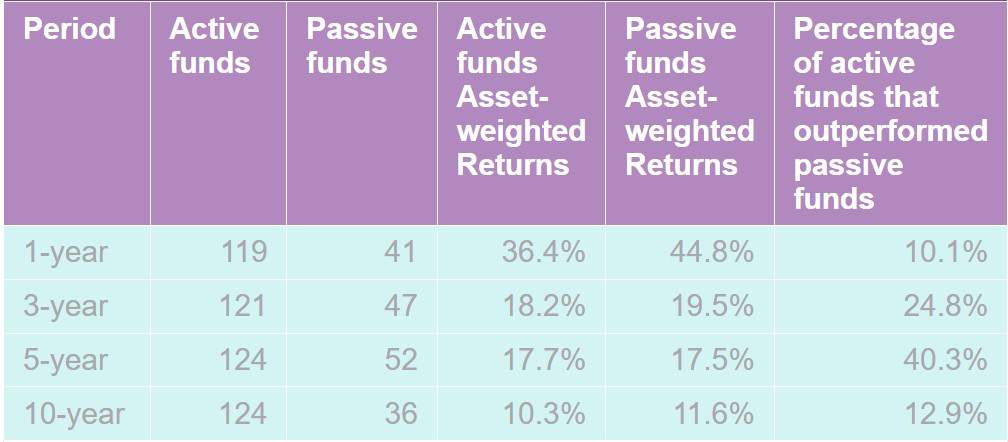
Michael Dodd, manager of selection services at Morningstar, said Morningstar's recent Morningstar Active Passive Barometer report showed that only 10 percent of actively managed South African equity managers outperformed the average returns achieved by passive funds last year.
The report shows that 119 actively managed equity funds achieved a strong average return of 36.4 per cent, while 41 passive equity funds achieved an average return of 44.8 per cent.
These average returns are calculated using weights corresponding to the amount invested in each fund (asset-weighted).
Spanjaard projects that 80 percent of active managers will beat the index in 2024.
Active funds perform better than passive
Source: Morningstar South African Active/Passive Barometer 2025
Why don't managers chase leading stocks?
Wim Murray, portfolio manager at Ford Asset Management, says the FTSE JSE All Share Index (ALSI), which local passive equity funds track, reflects the fact that South Africa is a resource-rich country. This leads to more instability. After a year like last year in which resource stocks have performed well, investors have gained larger weightings in their portfolios in index-tracking funds. However, they also face the risk of the price of those shares falling further than they did a year ago.
Murray said resource stocks now make up 30 percent of the index, compared with about 10 percent of the leading world index, the MSCI World Index, and five percent of the leading US index, the S&P500 Index.
Mikhail Motala, PSG's equity portfolio manager, said that without active management, the PSG SA Equity Fund would have outperformed last year by four percentage points, but it would have ended the year with 15 percent of the portfolio in platinum group metals (PGMs). That said, at this point in the cycle, you want to be counter-cyclical. Index positions and movements are cyclical.
posts vary
Dodd pointed out that Rezko's equity fund had no exposure to resource stocks. Spanjaard said managers prefer companies that are more valuable and compound every year, such as Capitec or Standard Bank.
Spanjaard said Rezko doesn't see precious metals miners compounding. Dollar charts for Gold Fields, one of the largest gold miners, show shares haven't gone anywhere in 50 years, he said.
Motala said that while it is true that diverse miners have not consolidated over the past 50 years, there has been an inflection point – the supply of minerals has decreased, miners' cost bases have changed and inflation is stagnant.
He said PSG had put a short load on PGM miners in 2024, but after researching the sector it was decided there was an investment case: because demand issues related to electric cars were so top of mind, no one was paying attention to the growing supply gap.
Murray said he agreed that the price has overemphasized demand over supply, but he said Ford had a short position in resource stocks because their prices were influenced by volatile retail investors who may have sold.
Spanjard agreed, saying that while retail investors are dangerous, the poor holdings of these stocks make them very risky. He said managers do not know whether the price of gold will double or halve.
Kruger said M&G does not typically hold gold but has changed its view on 2022 and 2023 because of a shift in the gold market that has been underappreciated by investors globally.
He said although no one can predict the price of gold, he knows the valuation of a miner like Anglo Gold, that it will generate cash flow of Rs 100 billion this year which it cannot allocate and it will return the money to shareholders. So he was happy to get the stake.
Why did precious metals perform so strongly?
Unathi Loos, portfolio manager at M&G Investments, said South Africa, as a major mining country, benefited from global trends last year when demand for critical minerals increased due to global geopolitical tensions and competition for secure supply.
However, Loos warned that although the region is currently benefiting from strong prices in some resources, commodity cycles are volatile. Prices could far exceed the cost of removing resources from the ground, he said.
Long-term investing requires careful risk management, not just focusing on short-term price appreciation. Long-term investors should focus on where demand will be in 10 years and where prices are likely to be in 10 years. He said that some projects take up to 15 years to complete.
However, the market capitalization index will reflect price movements and the composition of the shares of resources in the index will react to commodity and business cycles as demand and supply of resources change, Luce said.
The conference heard that there was demand for coal as a result of the Russian Ukrainian War, PGMs were in demand for electric cars, there was demand for gold as a safe alternative to the US dollar and US Treasuries, while copper was in demand for artificial intelligence.
Loos said that although there are cycles within cycles, there is currently a structural change – the need to secure critical minerals, which is supporting higher metals prices.
What does this mean for your investments
Last year's market performance, and the performance of the funds that track it, was extraordinary, but it was also unusual. Investors should know this:
- Active funds may have underperformed the index
Active funds may have underperformed the index because they were more diversified than the index.
Their role is to balance returns and risk – not to chase sector-specific upsides.
- Passive funds exposed to commodity cycles
Passive funds could have up to 30 percent in resource stocks, which would work in 2025, but this could put you at risk of declines in investment values if the commodity cycle turns.
Diversification remains a powerful long-term strategy. Index-trackers may outperform over the long term, but there will be periods of better and worse performance, as their concentrations in different market sectors are favorable or not favorable.
Demand for critical minerals should ensure that the resources sector continues to provide good – but volatile – returns for South African investors.
This article was first published SmartAboutMoney.co.zaan initiative of Association for Savings and Investments South Africa (Asisa).
For detailed fund information – including Unit Trust Comparison Tool, investment calculator And investment industry research – Go FundHub.co.za.
News24 encourages freedom of speech and expression of diverse views. Therefore, the views of the columnists published on News24 are their own and do not necessarily represent the views of News24.
News24 cannot be held liable for any investment decisions made based on advice given by independent financial service providers. Under the ECT Act and to the fullest extent possible under applicable law, News24 disclaims all responsibility or liability for any damages resulting from the use of this site in any manner.