
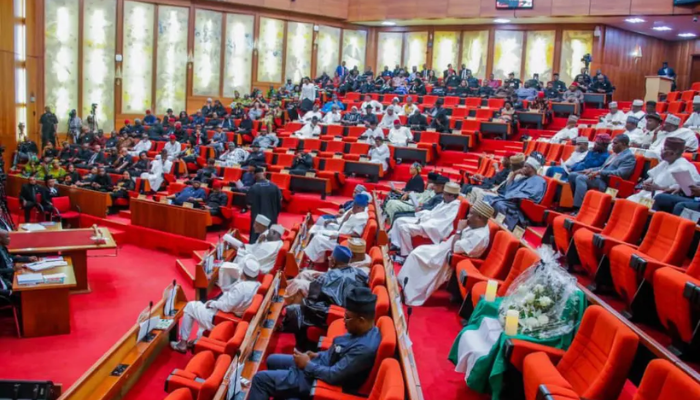
The Senate on Tuesday rejected Nigeria's proposals to seize South African-owned businesses such as MTN and DStv in response to renewed xenophobic attacks on Nigerians in South Africa, opting instead to press for stronger diplomatic engagement and accountability from Pretoria.
The debate marked the second time in two months that the Red Chamber discussed rising attacks targeting Nigerians and other African nationals living in South Africa.
Condemning the violence, the lawmakers resolved to urge the Federal Government through the Ministry of Foreign Affairs and the Nigerian High Commission in South Africa to seek written guarantees from the South African authorities on the safety of Nigerians following the expiry of the June 30, 2026 ultimatum issued by the vigilante groups.
The Senate also demanded the arrest and prosecution of all those responsible for the killings, intimidation, looting and illegal immigration enforcement.
Among the resolutions considered was a resolution titled The need to stop the repeated xenophobic attacks and intimidation against Nigerians and other African nationals in the Republic of South Africa, sponsored by Senator Asuquo Ekpenyong (APC, Cross River South).
Moving the motion, Ekpenyong said the Senate “notes with grave concern the new wave of xenophobic attacks, intimidation and anti-foreigner vigilantism against Nigerians and other African nationals resident in the Republic of South Africa.”
He said anti-immigrant groups had “issued an illegal ultimatum requiring undocumented foreign nationals to leave South Africa by 30 June 2026,” adding that the deadline was “accompanied by reports of widespread fear, demonstrations, displacement and violence, including attacks on foreign-owned businesses and homes.”
Also read: Senate challenges Tinubu on insecurity, asks FG to stop readmitting repentant Boko Haram members
According to him, the scope of intimidation has now extended beyond undocumented immigrants.
“Are aware that the threats have extended beyond undocumented migrants to Nigerians and other foreign nationals with valid residence, work and immigration permits, some of whom have reportedly been threatened, profiled, evicted or ordered to leave by unauthorized surveillance groups.”
He argued that the attacks could no longer be viewed as immigration enforcement.
“Noting that the indiscriminate targeting of foreign nationals, including legal residents, demonstrates that the campaign cannot be construed as mere immigration enforcement, but rather constitutes xenophobic hostility based on nationality and perceived foreign origin.”
Ekpenyong reminded the Senate of Nigeria's historical support for South Africa during the anti-apartheid struggle.
“It also observes that Nigeria's solidarity with South Africa was not limited to government action, as Nigerian workers, students and other citizens made significant contributions to the anti-apartheid struggle, while educational institutions and public facilities throughout Nigeria continue to bear Nelson Mandela's name in recognition of his sacrifice and enduring legacy.”
He further recalled that Nigeria had provided diplomatic, financial and material assistance to the liberation movement of South Africa and, under the military administration of General Olusegun Obasanjo, hosted the 1977 World Conference on Action against Apartheid while adopting economic sanctions against apartheid-era interests.
Ekpenyong expressed concern that although Nigerian businesses in South Africa were attacked and abandoned, “South African-owned enterprises and brands, including MTN and DStv, continue to operate legitimately and profitably in Nigeria, with Nigeria consistently upholding the rule of law by rejecting retaliatory measures against South African citizens and legitimate commercial interests.”
The Senate later called on the Federal Government to ensure that those behind the attacks are brought to justice while seeking formal assurances from South Africa on the safety of Nigerians.
The MPs also urged the Ministry of Foreign Affairs, the Nigerian Diaspora Commission (NIDCOM) and the Nigerian High Commission in South Africa to strengthen emergency consular services and compile a verified register of Nigerians who have suffered death, injury, displacement, unlawful detention or loss of business and property to facilitate legal redress, redress and compensation.
Furthermore, the Senate called on Nigeria to work with other affected African countries and the African Union to establish early warning, monitoring and accountability mechanisms against xenophobic violence across the continent.
The Upper House directed its committees on Foreign Affairs and Diaspora and NGOs to review the implementation of the Senate's May 5, 2026 resolutions and past Nigeria-South Africa relations and report within four weeks on actions taken, assurances received and outstanding issues.
During the debate, Adams Oshiomhole (APC, Edo North) proposed an amendment calling for economic retaliation over South Africa's refusal to compensate Nigerians affected by the attacks.
He said, “I rise to move an amendment to the motion. I was concerned by comments by a South African minister suggesting that compensation would not be paid to Nigerians whose property was looted, shops were burnt, businesses were destroyed, and lives were lost during recent xenophobic attacks.”
Oshiomhole proposed that, “If indeed the South African Government refuses to compensate affected Nigerians, it is proposed that the Federal Government of Nigeria should consider appropriating the profits made by South African companies, including their banks and other businesses, operating in Nigeria, and use those funds to compensate Nigerian victims.”
He added, “The ultimatum allegedly given to Nigerians to leave the country by June 30 was enforced by the mob while the South African government appeared incapable of protecting innocent people. We cannot allow Nigerians to suffer such losses and then use Nigerian taxpayers' money to compensate them while South African businesses are making profits here.
“I therefore urge that the profits made to South African companies in Nigeria be appropriated and used to compensate Nigerians whose businesses were destroyed and whose loved ones were killed.”
Senator Wasiu Eshilokun (APC, Lagos Central) also promoted the nationalization of South African businesses operating in Nigeria.
However, the Deputy Chairman of the Senate, Senator Barou Jibrin (APC, Kano North), who chaired the plenary session, ruled against the motion, insisting that the Senate should wait for the report of its Committee on Foreign Affairs before taking further action.
Barau said, no one in this chamber is happy with what is happening in South Africa. The actions of violent groups attacking innocent people are completely unacceptable. Killing people in the name of protests cannot and should not be tolerated.
“However, we also need to exercise caution. As Senator Oshiomhole rightly said, we should not completely rely on statements circulating on social media without proper verification.”
He said the South African minister's comments were misunderstood.
“I watched the interview that was being referred to. The South African minister explained that people occupying illegal settlements without legal title will not receive compensation because they have no legal title. However, those who have legal ownership of property will retain their ownership rights, even if they are displaced.
“However, this explanation does not excuse the failure to prevent innocent people from being displaced in the first place.
“If the South African government is facing internal security challenges or coordinated efforts to destabilize the country, it should come out openly and let the international community know.
“We are fellow Africans, and as long as stability requires it, we can always cooperate.”
Appealing for patience, he said, “For now, I appeal that we allow the Senate Committee on Foreign Affairs, chaired by your distinguished colleague and former governor, to complete its investigation before taking further decisions. Let the committee do its work and present its findings.”
However, Oshiomhole insisted that the Senate had already delayed action.
“Mr. President, with deep respect, this matter was widely debated about a month ago.
“Under your leadership, the Senate decided that the Foreign Affairs Committee should investigate the situation. You also suggested that a delegation be sent to South Africa.”
He further explained, “Respectfully, it should not appear that we now have to wait for further opinion before acting on our previous decision. We should not waver until more Nigerians are killed.”
Responding, Barau directed the committee to expedite its work.
“Chairman of the Foreign Affairs Committee, you are given two weeks to submit your report so that this Senate can take decisive action on this matter,” Barou said.
“Very good. The Foreign Affairs Committee has been directed to submit its report within two weeks on the attacks against Nigerians and other African nationals in South Africa. We need comprehensive information so that this Senate can determine the appropriate course of action.”
He also praised the response of the federal government.
He said, “Let me also note that the Federal Government of Nigeria, through the Ministry of Foreign Affairs and the Nigerian High Commission in South Africa, is actively dealing with the situation and providing assistance to affected Nigerians.
“The Government is doing well. Your contribution calls for greater attention to the situation, which is welcome. I can assure the Chamber that the Nigerian authorities remain in regular contact with our citizens in South Africa.
“We hope that the South African government will also look inward and decisively address the actions of those who carried out these heinous attacks under the cover of protests. Justice must be served for the Nigerian and other African citizens who have been killed, injured or displaced.”

