
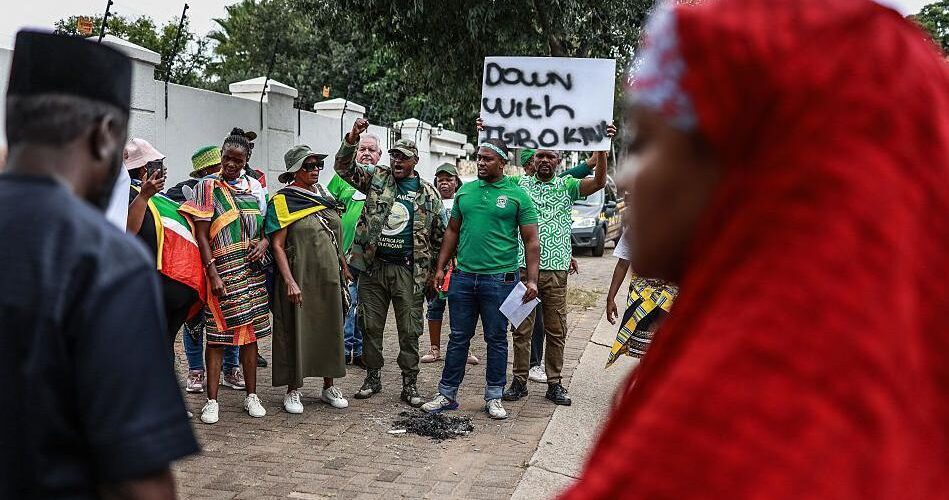
Nigeria's High Commission in South Africa has urged its citizens to remain vigilant after anti-illegal immigration protests in the Eastern Cape province turned violent.
On Monday activists were holding a peaceful march in the port city of Kugompo (formerly East London). But chaos broke out when a protester said he was attacked by a foreigner, leading to protesters damaging several vehicles and shops.
The issue has come amid recent tensions in the city over the installation of a Nigerian community leader, whose traditional title can be translated as “King of the Igbo people in East London”.
Some South Africans in the local area saw this as an attempt to seize political power.
Traditional leader Xanti Tsigkavu, who was at Monday's march, told broadcaster Newsroom Africa that the installation ceremony had left local chiefs feeling “vulnerable” because the area was “the territory of the Xhosas”.
According to official figures, South Africa is home to about 2.4 million migrants, which is just less than 4% of the total population.
Most come from neighboring countries such as Lesotho, Zimbabwe and Mozambique, which have a history of providing migrant labor to their wealthier neighbors. A small number come from Nigeria.
Xenophobia has long been an issue in South Africa, sometimes resulting in deadly violence, and anti-immigrant sentiment has become a major political talking point.
South African officials, including Kugompo Mayor Princess Faku, condemned Monday's incident, in which 10 vehicles were set on fire and locally and foreign-owned shops were looted.
Faku, who is associated with the African National Congress, said, “We supported the march because it is part of efforts to defend our sovereignty, but violence cannot be ignored. Violence does not solve problems… It is very sad that such an important march turned into violence and anarchy.”
No arrests have been made.
The Nigerian High Commission has urged its citizens to limit movement and avoid public gatherings while tensions remain high.
The protests were organized by various civil society groups and political parties.
A fortnight ago, Solomon Ogbonna Eziko was recognized as “Eze Ndi Igbo East London” by local diaspora members.
It is a common practice among Igbos living away from home to establish “Eze Ndi Igbo”.
The Igbo people, prominent in the south-east of Nigeria, are one of the largest ethnic groups in the country and prominent in the diaspora.
While members of the Igbo community in Kugompo recognize Eziko as their leader, his title is ceremonial and has no political meaning or cultural significance outside his community. Within the group, they are recognized as arbiters of minor disputes and invited to local functions.
Dr ABC Okokoh, a leader of South Africa's Igbo community, confirmed this, telling national broadcaster SABC that the ceremony recognizing Eziko was a “private event”.
He said, “We have not come here to establish any state (or) king because there are laws in this country that must be respected.”
He apologized for the “consequences” that resulted from the incident.
Some South African cultural experts condemned the establishment of Eziko as illegal and a violation of traditional protocols.
The Eastern Cape's Department of Co-operative Governance, which oversees traditional affairs in the province, distanced itself from the event and called for respect for the country's laws.
During a siege of the Nigerian High Commission by civil society groups in Pretoria on Tuesday, a diplomat also apologized to South Africans for the developments following Eziko's recognition.
Additional reporting by Adeline Okere and Chimezie Uchegbo
More BBC stories on South Africa:
(Getty Images/BBC)
Go bbcafrica.com For more news from the African continent.
Follow us on Twitter @BBCAfricaon facebook BBC Africa or on instagram bbcafrica