
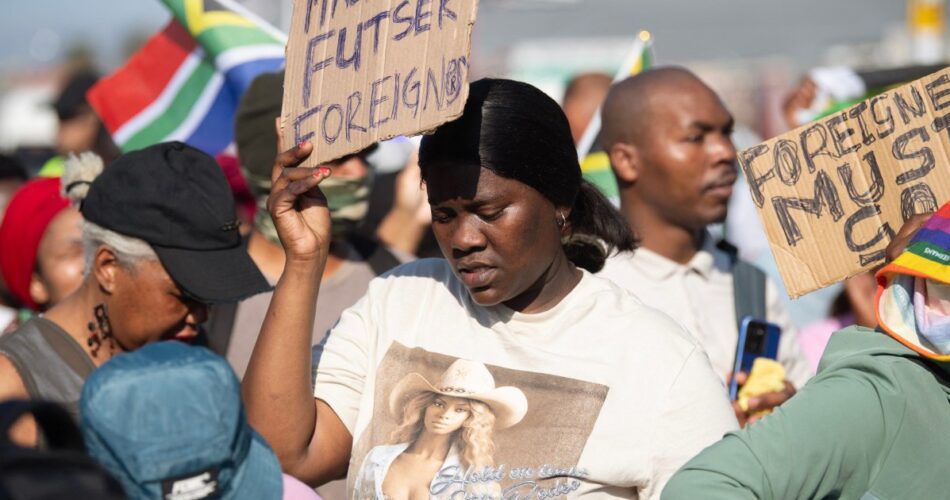
As South Africans prepare for elections in November, concerns about undocumented migration are overriding traditional local government issues such as service delivery, infrastructure, water supply and electricity.
Growing public concern over immigration, border control and the presence of undocumented immigrants has become one of the most contentious political issues in the country, with fears now rising over anti-immigration protests scheduled for June 30.
The debate comes against a backdrop of high unemployment, slow economic growth and worsening inequality, pressures many South Africans believe are increasing competition for jobs and public services.
Recently Published Related Articles:
— Foreign-owned spa shops come under scrutiny as debate over business visa figures erupts
— Inside Mussina: The border town is torn between economic survival and anti-immigration tensions
— eThekwini Mayor to detail latest interventions in Malawi's repatriation process
Concern over undocumented migration
Speaking on the issue, Dr Oscar van Heerden, a senior researcher at the University of Johannesburg, said there is no doubt that anti-immigration movements have affected many South Africans.
He argued that repeated tensions around immigration show that despite various government interventions the root causes of the problem have not been adequately addressed, adding, “They have created panic.”
Van Heerden said South Africa is attracting migrants from neighboring countries as well as far-flung countries, including countries like Nigeria and the Democratic Republic of Congo.
“The truth of the matter is that we have a lot of undocumented (migrants) in South Africa,” he said.
They welcomed efforts by Governments in the Southern African region to recognize that migration is not just a South African challenge but a broader regional issue.
Border controls and migrant numbers remain uncertain
A major challenge facing policy makers is the lack of reliable data on the number of undocumented migrants living in South Africa.
Van Heerden said porous borders make it possible to track documented migrants with valid visas and permits, but the number of undocumented migrants is extremely difficult to estimate.
“It is absolutely impossible to estimate how many illegal people there actually are in South Africa,” he said.
He said it is widely believed that migrants from Zimbabwe, Mozambique and Malawi constitute a significant portion of undocumented migration to South Africa, although exact figures are unknown.
According to Van Heerden, there is widespread acceptance that Zimbabwe has the largest share of both documented and undocumented migrants due to that country's long-running economic and political difficulties.
Fear of unrest ahead of planned protests
There are also growing concerns about the possibility of violence during the planned demonstrations.
Recent marches have seen protesters carrying weapons and demanding documentation from individuals, raising fears of escalating tensions.
Van Heerden warned that authorities must be adequately prepared to prevent a repeat of previous incidents of unrest.
“If our public policing is actually as bad as it has been, we're going to be in serious, serious problems,” he said.
He argued that law enforcement alone would not be enough and called for engagement with anti-immigration campaigning groups to better understand their frustrations and concerns.
'We can't fight our way out of this'
Van Heerden also questioned whether deportation could provide a permanent solution to undocumented migration.
When asked if South Africa could overcome this problem, he said, “We simply cannot.”
He cited the financial costs of deportation and the underlying political and economic conditions in neighboring countries that continue to drive migration to South Africa.
According to Van Heerden, sustainable solutions will need to address the root causes that drive people to leave their countries in search of opportunities elsewhere.
Call for regional action
Van Heerden said regional institutions such as the Southern African Development Community (SADC) should play a stronger role in tackling the governance and economic challenges that contribute to migration flows across the region.
He argued that political and economic pressure may be needed to encourage reforms in countries facing chronic instability, adding that migration pressures were unlikely to ease unless conditions beyond South Africa's borders improved.
Acknowledging that such measures may have short-term consequences, he said policymakers should focus on long-term solutions rather than temporary fixes.
He also called for a greater role for civil society organizations and non-governmental organizations across the region to help address the factors driving migration.
As South Africa approaches its next elections, immigration, undocumented migration and border management will remain among the most hotly debated issues, reflecting broader concerns about jobs, public services and economic opportunities.