
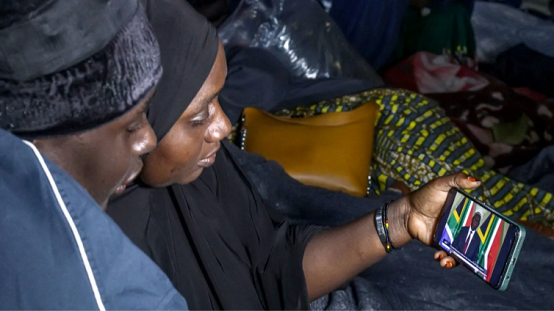
South African President Cyril Ramaphosa has addressed the nation to announce new measures to crack down on illegal migration, as tensions rise over anti-foreigner marches and frustration over high unemployment.
These steps include jailing employers who hire undocumented workers, setting up dedicated courts to expedite the deportation of undocumented immigrants, and keeping a register with biometric data “for every person in the country” to prevent identity theft.
But he also warned South Africans not to take the law into their own hands.
Over the past few weeks, several African countries have been organizing the evacuation of some of their citizens as fears of violence increase.
Anti-immigrant groups are demanding that undocumented migrants leave the country and have set a deadline of June 30.
Last weekend, several hundred African migrants fled their homes following reports of door-to-door bullying in the Overberg region of South Africa's Western Cape province, as well as the death of two Mozambicans in Mossel Bay.
Many sought shelter in community halls, beaches or nearby mountains. Some have chosen to return home – and this weekend another group of about 140 people boarded buses to Malawi and Mozambique.
In Durban, foreigners have been camping outside the city's Home Affairs Department for several weeks, saying they fear for their lives.
Ramaphosa acknowledged that illegal migration is placing undue pressure on South Africa's public services – and that the issue needs to be addressed by his government.
To do this he created a five-point strategy by which:
- Cracking down on those who violate immigration laws
- strengthening border security
- Curbing corruption within the immigration system
- closing loopholes in immigration law
- Working with other African countries to tackle the problem.
But he warned against vigilantism: “Let me make it clear that only authorized government officials can take action against violations of the law, including violations of our immigration laws.
“For example, another person is not allowed to confront someone on the street to ask for proof of nationality.”
Some analysts have suggested that the resurgence of anti-immigrant sentiment in South Africa may be linked to local elections in November.
The President said authorities would not allow groups to use legitimate concerns to “destabilize” the country by inciting violence.
“We will take action against forces who are exploiting our people's concerns about illegal immigration to advance their political, personal or criminal agendas,” he said, cautioning against social media campaigns that spread misinformation and lies about foreign nationals.
He also told South Africans that “there is no room for xenophobia, racism, sexism, Afrophobia or any other form of intolerance in South Africa”.
He said, “Our country – like many other countries throughout history – is a product of migration. It is the reason for our diversity and contributes to our vibrancy.”
According to official figures, there are more than 3 million foreigners living in South Africa, about 5% of the population – but many more are believed to live without papers.
During his 30-minute speech, the President pointed to the scale of the problem and how “illegal migration routes are increasingly overlapping with organized crime”.
“In the last year alone, border management authorities managed to intercept and stop more than 450,000 people attempting to enter South Africa illegally,” he said.
Ramaphosa described how unscrupulous employers pay undocumented migrants well below the minimum wage and “only” pay fines if caught.
He said a plan has been launched to appoint 10,000 inspectors to crack down on such businesses and those found guilty will face stringent punishment, including imprisonment.
Illegal migration is also often possible due to corruption, the President acknowledged, and described how officials sold documents.
Authorities will shut down green ID books, which have made it possible for undocumented immigrants and identity theft by criminal syndicates, the president said, part of a plan for everyone to have one digital ID in the future.
Another imminent change announced was the relocation of refugee reception centers to border checkpoints.
Ramaphosa noted the anger expressed by many communities over the number of foreign nationals running small grocery shops, known as spaza shops, in townships.
They have been frequently targeted during the waves of xenophobic violence that have swept South Africa over the past few decades.
Ramaphosa said efforts would be made to ensure that all informal shops were properly registered by the Department of Small Business Development.
Quotas were also to be set for “the employment of foreign nationals in any economic sector or occupational category”, he said.
South Africa has one of the highest unemployment rates in the world, at around 33% – which mainly affects young people.
Ramaphosa said he would send envoys to other African countries to outline these new measures, adding that peace and economic development elsewhere were important factors.
And he ended on a positive note, saying he hoped the changes would help create a “safe, lawful, compassionate and prosperous” country.
“South Africa has overcome greater challenges than this. We have overcome division. We have overcome conflict. We have overcome injustice. We will overcome this challenge too.”
BBC