
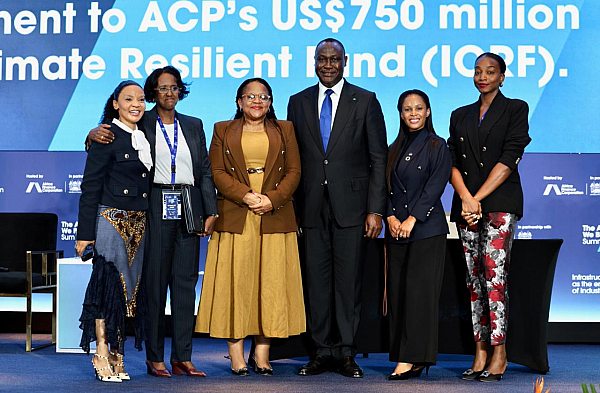
Africa Finance Corporation (www.AfricaFC.org), the continent's leading infrastructure solutions provider, yesterday announced a commitment from the Development Bank of Southern Africa (DBSA) to its US$750 million Infrastructure Climate Resilient Fund (ICRF). Agreement signed in AFC continues The Africa We Build Summit In Nairobi, the initiative is an important step in scaling up climate adaptation finance across Africa and emphasizes strengthening African institutional alignment around infrastructure as a catalyst for climate resilience, regional integration and long-term economic transformation.
Managed by the Corporation's asset management subsidiary AFC Capital Partners (ACP), the ICRF is a leading infrastructure fund designed to climate-proof Africa's infrastructure by incorporating resilience measures across the entire asset lifecycle, from planning and design to construction and operation. The Fund directly addresses a critical development challenge facing the continent: ensuring that infrastructure systems can withstand increasingly severe and unpredictable climate impacts.
DBSA's commitment to the ICRF reinforces the growing African institutional alignment and momentum around climate-resilient infrastructure as a distinct and investable asset class. The fund has already attracted strong participation from leading global and African institutional investors, including a US$253 million commitment from the Green Climate Fund (GCF) – its largest equity investment to date in Africa – along with the European Investment Bank (EIB), the Nigeria Sovereign Investment Authority (NSIA) and several African pension funds. The entry of the DBSA further strengthens the Fund's position as a leading vehicle for mobilizing climate finance into transformative climate-resilient infrastructure across Africa.
The ICRF is structured to attract both public and private capital into infrastructure projects that integrate climate resilience from the outset. By combining concessional and commercial capital, the Fund addresses long-standing market barriers that have historically hindered investment in climate adaptation in Africa. Through blended finance and targeted de-risking mechanisms, the Fund enables the integration of resilience measures that would otherwise be difficult to finance, thereby unlocking large-scale private capital.
Samaila Zubairo, President and CEO of Africa Finance Corporation, commented: “The ICRF is our response to a defining challenge – ensuring that Africa's infrastructure is built to withstand the growing impacts of climate change. With the continent losing an estimated 2% to 5% of GDP annually due to climate shocks and adaptation needs and needing to access $50 billion each year, the urgency is clear. That's why we are making a major contribution to the Fund. “We are pleased to welcome DBSA as a partner and reflect strong African institutional alignment and mark an important milestone in a partnership we look forward to deepening in the years to come.”
Boitumelo Mosako, Chief Executive Officer of the Development Bank of Southern Africa, commented: “Africa does not have the luxury of waiting. Climate shocks are outpacing adaptation finance, and vulnerable communities are bearing the greatest burden. This partnership with Africa Finance Corporation sends a clear signal that development finance institutions are pooling their mandate, capital and risk appetite to achieve what no single institution can accomplish alone.”
The fund brings together leading institutions including DBSA, AFC and GCF by combining their expertise, capital and climate mandate to accelerate investment in climate-resilient infrastructure. DBSA's participation reflects its mandate to drive infrastructure-led development across Southern Africa, support regional integration and mobilize private sector investment, while contributing to broader continental climate adaptation and development objectives.
Designed to explicitly address the systemic risks posed by climate change to Africa's infrastructure, the fund targets investments in renewable energy, transport and logistics, digital infrastructure and industrial development – sectors central to enabling low-carbon economic growth across Africa while strengthening the resilience of the continent's economic systems.
AFC Capital Partners' investment strategy integrates physical and transitional climate risks, including the risk of extreme weather events, emissions pathways and climate governance considerations. Each investment is subject to rigorous climate risk screening and assessment to ensure that resilience is built in from the outset and maintained throughout the infrastructure lifecycle, setting a new standard for the delivery of climate-resilient infrastructure in Africa.
The Green Climate Fund plays a catalytic role through the provision of first-loss capital and technical assistance for climate risk assessment and monitoring, helping to mobilize investment and crowd out additional institutional capital.
Through the ICRF, AFC Capital Partners expects to mobilize up to $3.7 billion in total financing, significantly increasing investment in climate-resilient infrastructure across Africa. The fund is building a diversified portfolio of 10 to 12 infrastructure projects across the continent, contributing to more resilient, connected and sustainable African economies.
Distributed by APO Group on behalf of Africa Finance Corporation (AFC).
Media Enquiries:
Yewande Thorpe
Communications
Africa Finance Corporation
Mobile: +234 1 279 9654
Email: yewande.thorpe@africafc.org
About AFC: :
The AFC was established in 2007 to be a catalyst for viable infrastructure and industrial investment across Africa. AFC's approach combines specialist industry expertise with a focus on financial and technical advice, project structuring, project development and risk capital to meet Africa's infrastructure development needs and drive sustainable economic growth.
Eighteen years later, AFC has developed a track record as the preferred partner in Africa for investment and delivery of high quality infrastructure assets providing essential services in the core infrastructure sectors of energy, natural resources, heavy industry, transport and telecommunications. The AFC has 48 member states and has invested more than US$19 billion in 36 African countries since its inception.
About DBSA:
The Development Bank of Southern Africa (DBSA) is one of the leading development financial institutions on the continent. DBSA's primary objective is to provide impactful development finance solutions that ignite transformational change in South Africa and the rest of the African continent. Improving the quality of life of people in Africa is the core focus of its development impact. DBSA aims to turn the wheel of history towards shared prosperity through multifaceted investments in sustainable infrastructure and human capacity.
DBSA's product solutions span all stages of the infrastructure development value chain from infrastructure planning and project preparation to financing and non-financing investments to infrastructure implementation and delivery. Its primary areas of focus include energy, ICT, transport, water and sanitation and secondary areas of focus including education, housing and health.