
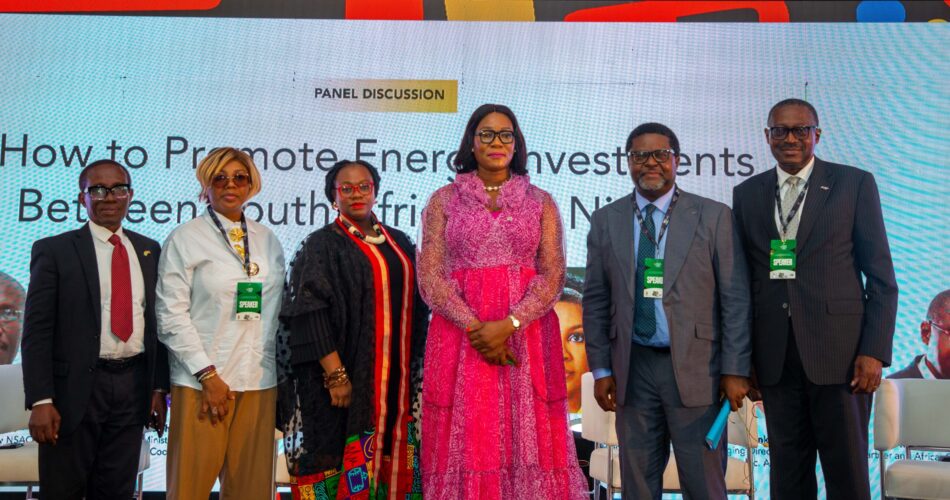
Industry players have said that for Africa to develop as an energy superpower, strategic cooperation between Nigeria and South Africa is crucial to achieve this goal.
At the fourth edition of South Africa Week in Lagos on Wednesday, industry players from the energy sector stressed the important role of cooperation in ensuring that both countries take advantage of opportunities including private investment, technology and business partnerships.
Themed for 2026, 'South Africa-Nigeria Partnership: Unlocking Infrastructure Investment Opportunities', speakers stressed the strategic importance of energy diplomacy, cross-border cooperation and infrastructure investment in advancing Africa's economic growth and energy security.
Thandi Moraka, South Africa's Deputy Minister of International Relations and Cooperation, said a reliable energy supply is fundamental to attracting foreign direct investment and sustaining economic growth.
“Without sustainable energy systems, countries risk limiting industrial growth and undermining investor confidence. We must then work together to closely align all our missions with our Agenda 2063, where we need to build the Africa we want,” he told the conference.
Energy was deployed not only as an economic necessity but also as a strategic tool of foreign policy, emphasizing the importance of energy diplomacy in shaping bilateral and regional relations.
Moraka noted the need to enhance cooperation between Africa's most populous country and South Africa, describing the two countries as key players in Africa's energy landscape.
“The shared goal is to create a continental energy market that not only meets local demands but also exports surplus energy, supporting any economic development initiatives and energy security across our beautiful continent of Africa.”
Industry experts at the conference emphasized the role of the African Continental Free Trade Area (AfCFTA), which was identified as an important platform to advance energy cooperation across the continent.
Moraka pointed out that AfCFTA provides a unique platform to facilitate intra-Africa trade initiatives, including in energy commodities, equipment and technology, continuing to encourage key players. He called for strategic partnership with Nigeria that can reduce trade barriers
The 2026 edition of economic ties between South Africa and Nigeria holds special significance, coinciding with the 30th anniversary of South Africa's democratic constitution and 32 years of unbroken diplomatic relations between the two African countries.
These milestones underline the enduring partnership between the two countries, rooted in shared history and strengthened through formal agreements and ongoing cooperation.
On grid and distribution issues limiting the delivery of available power and driving heavy reliance on off-grid generation, Pedro Omontumen, partner at PricewaterhouseCoopers (PwC), said private capital will play a central role in scaling up energy infrastructure, improving operational efficiency and accelerating project delivery across the value chain.
“Growing opportunities in gas-to-power, renewable energy and transmission infrastructure position Nigeria as a key market for long-term energy investments,” oil and gas expert Omontuemhen said.
According to him, structural grid limitations and not generation capacity are the primary constraints on electricity supply in Africa. He described Nigeria's electricity challenge as not a lack of resources but distribution constraints.
However, Omontuemhen said the complementary strengths of Nigeria and South Africa create opportunities for scalable energy investment, but this will all depend on strong market discipline, regulatory enforcement and continued investment in bankable infrastructure.
All speakers hinted at the same basic point: for Africa to grow as a net supplier of crude oil and other African countries to replicate another Dangote refinery, collaboration is key.
Currently in South Africa, Omontuemhen pointed out that bilateral trade is structurally unbalanced. South Africa exports an average of $468.48 million of crude oil and imports about $1.69 billion, resulting in a deficit of $1.22 billion.
“This dynamic is largely driven by South Africa's dependence on Nigerian crude oil, positioning the relationship as one of strategic interdependence rather than singular imbalance,” he said.
Africa's combined economic output could reach $3.32 trillion by 2036, with Nigeria and South Africa remaining the leading economies.
Managing Director of Nekonde Energy Limited, Chichi Emenike, said industrialization and employment expansion is impossible without reliable energy access. But with Nigeria's abundant oil and South Africa's advanced infrastructure, it creates opportunities for joint investment and technology transfer.
“The amount of energy that is available and accessible cannot be overstated,” Emenike said.