
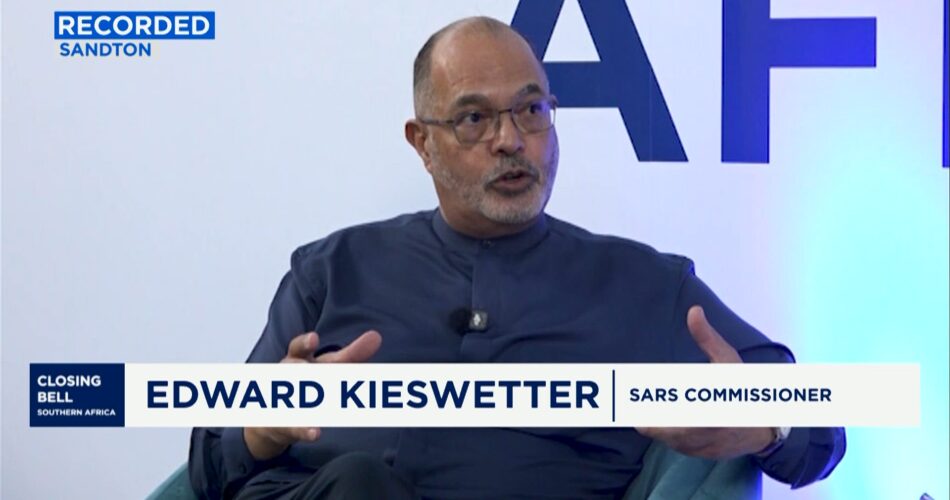
South African Revenue Service Commissioner Edward Kieswetter said the final hours of the financial year are the most intense in the country's public finance calendar, underscoring that the ability of SARS to meet its revenue target is central to maintaining confidence in South Africa's fiscal framework.
Speaking to CNBC Africa ahead of SARS's provisional revenue announcement for the 2025/26 financial year, Kieswetter described a frantic collection effort at the end of the year as the tax agency works until the last minute to secure the billions of rand still owed before the books are closed.
“March 31 is the end of the fiscal year, which means we still have a mountain to climb to collect those last billions,” Kieswetter said. “By 12 o'clock tonight, we will make sure all the money has come in, the books are balanced.”
His comments come as SARS prepares to release preliminary revenue results on April 1, a closely watched update for policymakers, investors and businesses looking for signals on the strength of tax collections and the health of the government's fiscal position. The announcement also comes as Kieswetter enters the final stages of his tenure, with his departure expected in April 2026.
Kieswetter said the structure of South Africa's financial year creates a sharp increase in year-end collections as it coincides with the closing of the first quarter and the end of the financial year for many large companies. This dynamic creates a “hockey stick effect” in revenue collection, he said.
To illustrate the scale, he said last year SARS had to collect R114 billion in the last two days of the financial year alone.
“It's frantic. It absolutely is,” he said, describing the pace of activity as banks stay open and SARS teams work through the night to collate the inflows and finalize figures.
This is a big stake not only for the tax authority but also for the broader credibility of the state's finances. Kieswetter emphasized that the Finance Minister's budget arithmetic depends on SARS meeting the revenue assumptions built into the fiscal framework.
“The minister makes an announcement. He depends on revenue to deliver fiscal balance,” he said. “If we don't achieve what they have set out for us, that does not bode well for integrity and confidence in the fiscal framework.”
This message is particularly relevant in a country where fiscal discipline, debt sustainability and state capacity are under close scrutiny by rating agencies, investors and the business community. A decline in tax revenues could widen the budget deficit, increase borrowing needs and complicate the government's broader efforts to stabilize public finances.
Nevertheless, Kieswetter declined to preview the final numbers before they were fully verified, saying that SARS would only know the exact results later in the night when payments had been processed and the settlement was complete.
“We won't know until about 10 p.m., 11 p.m. tonight,” he said, adding that the agency will brief the media in a lock-up session before publicly releasing the provisional results.
In addition to the immediate revenue tally, the interview also offered a window into Kieswetter's assessment of his time at the helm of SARS. Widely credited with rebuilding the institution after a long period of institutional erosion, he said his focus was not just on restoring SARS to its previous state, but also on preparing it for the future.
He said, “If you ask me what the definition of a stewardship leader is, the hallmark of stewardship is leaving an organization in a better place than you found it.” “We have not only restored SARS, as people say, to its former glory, but we have also future-proofed it.”
Kieswetter pointed to a new operating model designed for the artificial intelligence era, saying that SARS has moved beyond the first and second stages of digitalization and is now “AI ready.” He highlighted the use of auto-assessment, which has reduced the need to manually submit returns for many taxpayers, as one of the clearest examples of technology improving both efficiency and taxpayer experience.
He also said that AI has already strengthened the agency's fraud controls. According to Kieswetter, SARS used fraud risk detection tools last year to prevent improper refunds being paid, preventing approximately R100 billion in potentially inappropriate outflows.
Looking ahead, he said SARS is testing new forms of AI, including generative and agentic AI, to automate routine processes and support future service channels such as contact center voice functions and basic verification work.
Importantly, Kieswetter framed that technological change not as a threat to workers but as a change that requires investment in workforce capabilities. SARS is working to make employees “AI fluent” and “AI confident,” he said, enabling them to move into higher-value roles as automation takes over repetitive tasks.
The approach comes at a time when businesses globally are grappling with how to deploy AI without creating significant labor dislocation. Kieswetter acknowledged those broader concerns, referencing developments in advanced markets where AI is beginning to reshape job structures.
As far as the future leadership of SARS is concerned, the outgoing Commissioner refrained from setting a policy agenda for his successor, but set out a clear set of qualities he believed the role demanded. The next Commissioner must have strong character, the right technical and managerial capabilities, a proven record of delivery, an exceptional work ethic and above all, incorruptibility, he said.
He also stressed the importance of institutional independence, which is a sensitive and highly consequential issue for a revenue authority tasked with enforcing compliance in the economy without fear or favour.
Kieswetter said, “When I hand over the reins to my successor, my message will be: Maintain an independent mind, be true only to the law and your conscience and resist the temptation to be influenced by any constituency.” “Although we are employed by the government, we work for the South African people.”
His comments summarize the balancing act facing SARS in the coming months: preserving revenue momentum, strengthening taxpayer confidence, and modernizing the institution in a way that strengthens both administrative capacity and the country's fiscal credibility. With imminent provisional results and leadership succession approaching, investors and taxpayers alike will be keeping a close eye on whether the agency can sustain the transformation that Kieswetter said is now embedded in it for the long term.