
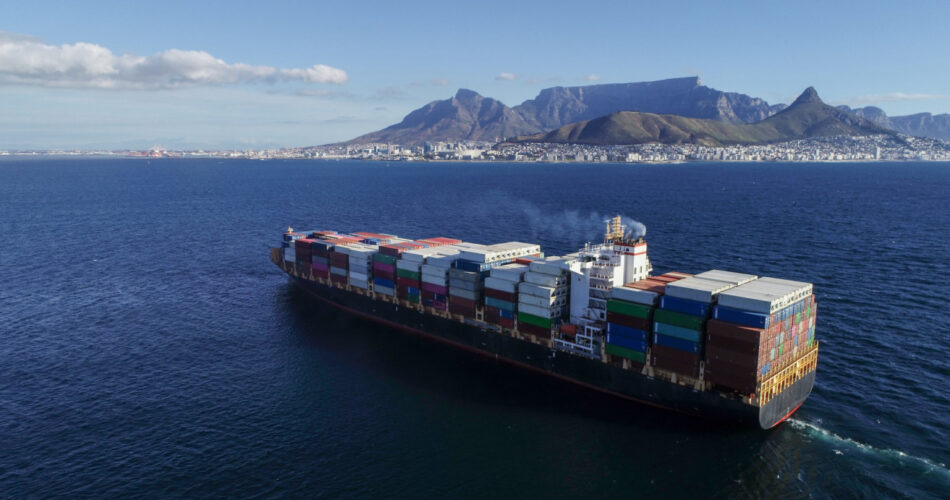
Cape rerouting highlights South Africa's marine blind spots
More ships are circling the Cape, but the ports, policy and strategy to turn the boom into sustainable profits have not yet been put in place.
Published in ISS Today on 29 April 2026
By
Daniela Margraff
Research Consultant, ISS and Junior Research Officer, University of Pretoria
timothy walker
Senior Researcher, Transnational Threats and Organized Crime, ISS
Navigating around the Cape of Good Hope does not always bring economic benefits, as South Africa's experience from October 2023 shows. The country has seen varying and often unintended impacts across commercial, security, environmental and policy areas.
This reflects the broader tension in its situation between short-term economic gains and long-term structural change, complicated by the absence of a national maritime security strategy. A recent closed roundtable organized by the Institute for Security Studies highlighted these tensions and challenged prevailing assumptions.
The first misconception is that changed vessel traffic automatically increases port revenues. Several major shipping lines have been rerouted around the Cape from late 2023 due to disruptions at Middle Eastern chokepoints.

Houthi attacks have made crossing the Bab-el-Mandeb strait more dangerous from 2023 to 2025. The disruption in the Strait of Hormuz has increased since the Iran war. Cape-bound diversion exceeds double From pre-crisis baselines.
The assumption is that increased ship traffic results in more port calls and more revenue from services such as berthing fees, cargo handling, bunkering (fuel supply), and repairs and maintenance. But data South Africa's main ports of Durban and Cape Town have seen no apparent increase in ship arrivals. Almost all converted ships traveling across the country are transiting rather than stopping to utilize its maritime services.
Traffic also increased spreading Operating space for illegal activities, creating economic and security risks. Non-state actors such as search and rescue organizations are increasingly exposed to criminal dynamics at sea. As the number of ships increases and routing patterns change, the burden of monitoring and surveillance increases, and the investigation of shipping becomes more complex.
Also, there remains a gap in information-sharing on nefarious activities. Diplomats at the roundtable said uncertainty over how to disseminate actionable intelligence on maritime crime remains problematic.
The increasing presence of uninsured or underinsured ships plying this route is further exacerbating these challenges. In South Africa's dangerous waters, such vessel accidents impose substantial financial and legal risks on the affected coastal state when they occur.
One participant said that without insurance, the financial burden ultimately falls on the state. grounding Nigerian tugboat leo About 18 nautical miles off South Africa's coastline, lives were lost and the vulnerabilities involved were exposed. A major pollution incident on the ecologically sensitive southern African coastline would have serious environmental consequences, along with unresolved questions of insurance, reputation and regulations.
The second prevailing perception is that South African ports are poorly positioned to fully benefit from this increased traffic. While they perform poorly at various levels measuresThe Port of Cape Town has shown symptoms There has been improvement since 2024. Nevertheless, shipping lines select routes and port calls that minimize diversions, delays, and costs.
Changes in shipping patterns and vessel specifications do not always align with existing port infrastructure, complicating the debate over access and capacity. As shipping companies adapt their operating models to improve efficiency and cut costs, ports cannot always keep pace. 'Port inefficiency' is sometimes a mismatch between the pace of change in global shipping and the relatively rigid port infrastructure.
Recent reports indicate that demand for bunkering off the coast of Africa has increased due to route changes. Still, it appears that South Africa is capturing some of these short-term gains Option Centers such as Namibia's Walvis Bay and Mauritius' Port Louis expand bunkering capacity and operations. These ports offer more predictable turnaround times and less regulatory and operational disruption than South Africa.
But both readings of increased traffic led the roundtable to discuss the risks while ignoring more consequential changes. South Africa may be positioning itself less for immediate gains and more for participation in a future decarbonized maritime economy.
In doing so, he will have to reconcile multiple agendas that do not fit together. These also include the ambition to become an international maritime Center The future is characterized by a shipping system that has undergone a structural transition to low- or zero-carbon fuels and technologies to meet the projected global maritime economy.
And it aims to do so while incorporating a massive developmental mandate built around employment generation in such a country Unemployment Is above 30%.
South Africa is building a policy and investment environment oriented towards a long-term transition and commercial participation in a decarbonized and global maritime economy, particularly green shipping fuel production such as hydrogen and ammonia. The Department for Transport's 2025–2030 strategic plan states that it has planned maritime decarbonisation roadmap.
However, decarbonization is particularly difficult to achieve because South Africa's ocean-economy agenda has historically included carbon-intensive non-renewable activities, including offshore oil and gas. Continued reliance on these leads to increasing tensions with emerging markets and regulations.
In fact, the Richards Bay Coal Terminal is one of the the biggest Coal terminals around the world, but global regulatory trends are toward lower emissions, cleaner fuels and stricter compliance.
The potential benefits from green alternatives are clear. 2024 Industrial Policy and Strategy of the Department for Trade, Industry and Competition Review says successful commercialization of green hydrogen in South Africa could add R188 billion to GDP, support 387774 jobs, and generate R29 billion in fiscal revenue by 2030. New infrastructure for the fuels of the future is needed to transform ports into green fuel production, bunkering and export nodes.
While the potential benefits from green hydrogen are significant, this transition is not without risks. South Africa's own strategic plan highlights that global decarbonization pressures could destabilize coal-dependence areas If change is rapid or poorly managed. The government has written two ambitions into one policy area: to develop and transform the sector while meeting stringent international environmental standards.
If it moves too aggressively toward costly market-based measures, it risks harming domestic constituencies that already see shipping, ports and the maritime economy as sources of jobs and industrial revival. If it appears too cautious, it risks undermining its own narrative. Help International Maritime Organization for decarbonization and its broader justice-transition narrative.
Attending the Cape of Good Hope only in times of crisis reflects a recurring pattern of widespread devaluation of the oceans and limited high-level engagement in South Africa's strategic thinking.
Maritime issues should be better placed at the center of government through clear political ownership, supported by an enhanced Maritime Security Advisory Committee that implements the National Maritime Security Strategy and ensures consistent involvement of key departments.
Please ask for permission to republish ISS Today articles email We. In South Africa, news24 ISS Today reserves the right to republish articles. in nigeria, Premium Times ISS Today reserves the right to republish articles.