
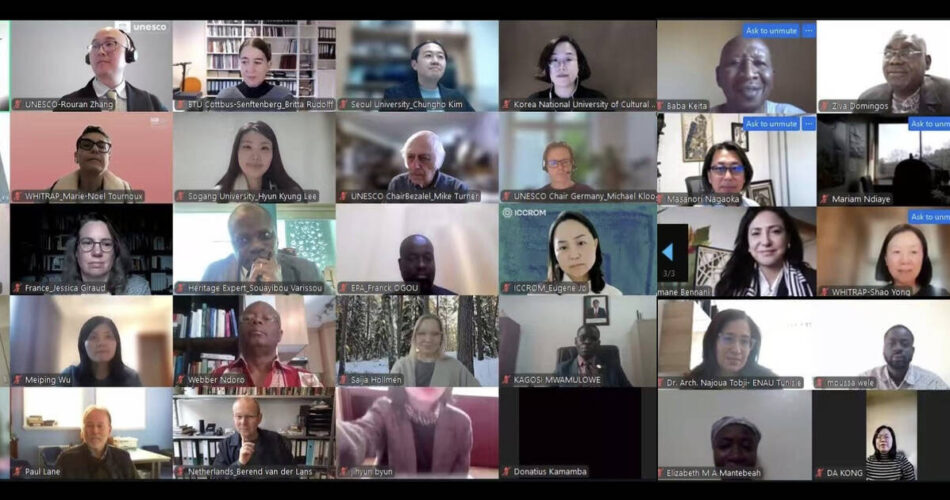
The UNESCO World Heritage Centre, under the generous support of the Korean Heritage Service of the Republic of Korea and the Korea Funds-in-Trust Initiative to Institutionalize Capacity Development for World Heritage in Africa, concluded a two-day virtual brainstorming on Strengthening World Heritage Higher Education in Africa on 23-24 February 2026.
The meeting brought together more than 100 experts from 28 African countries, as well as partner universities from 13 countries outside Africa. The context of the workshop is rooted in UNESCO's priority Africa and the World Heritage Strategy in Africa, which calls for strengthening African institutions, promoting South-South and North-South partnerships and enabling heritage sustainable development.
© UNESCO
The brainstorming was generated by a follow-up to the 2018 regional workshops in Great Zimbabwe and Senegal, and reflected on current World Heritage discourse, including the Nairobi Outcome Document on heritage and authenticity. In thematic sessions and roundtables, participants explored how university-based programs can move beyond short-term capacity-building workshops to training and long-term capacity-building to advance the empowerment of African institutions in higher education.
The discussions covered the curriculum framework for the World Heritage Convention; Linking cultural and natural heritage approaches; Harmonizing heritage with the built environment; Digital technologies and innovations for documentation and learning; and integrating tangible and intangible dimensions in education and capacity development. He also highlighted mentoring, job-creation/employment and more inclusive, Africa-informed approaches to teaching and practice.
“UNESCO will develop a shared roadmap that will translate today’s exchanges into concrete curriculum content, pedagogical approaches and partnership arrangements.”
© UNESCO
“The results of this workshop should be translated into concrete actions, including curriculum reform and new academic programs in African pilot universities.”
Building on the exchange, UNESCO will now work with African and partner universities, UNESCO Chairs, CHDA and EPA, African World Heritage Funds and advisory bodies to support five pilot universities in Cameroon, Morocco, Senegal, South Africa and the United Republic of Tanzania, to strengthen World Heritage curricula and establish campus-based heritage resource centres, while furthering the Pan-African network for sustained peer learning and collaboration.
For further information please contact:
Rouran Zhang, Program Coordinator, UNESCO World Heritage Center ((email protected))