
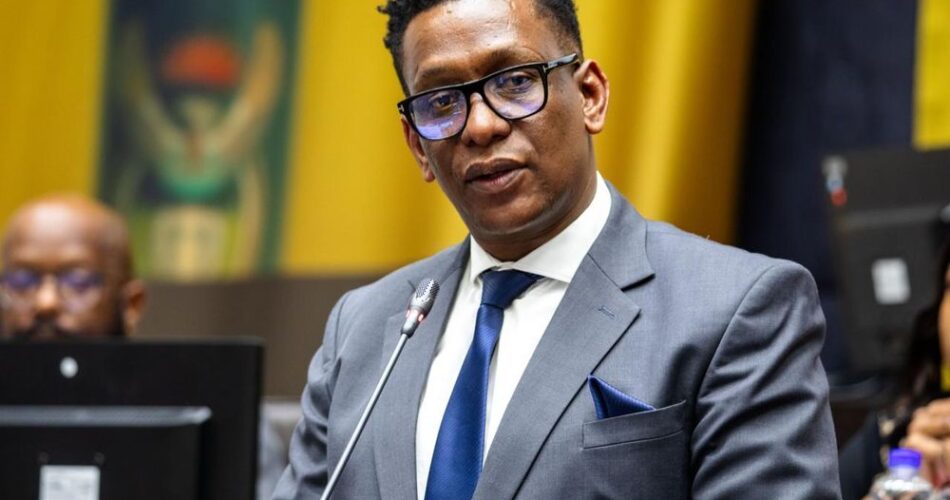
Tebogo Letsie, chair of the Portfolio Committee on Higher Education, has spoken out against a statement from Universities South Africa (USAF), saying the committee has faced growing concerns about the employment of foreign academics.
Letsie said recent comments by USAF Chief Executive Officer, Dr. Fethiwe Matutu, were “unfortunate and out of touch with reality.”
USF said it respects Parliament's oversight role, but is concerned that the issue is becoming increasingly politicized and devoid of the realities of how universities function in the global knowledge economy.
Matutu said the current debate risks distorting both the purpose and practice of internationalization in South African higher education.
“The idea that foreign academics are displacing local talent is not borne out by evidence or institutional practice… It is an unfounded misconception. In fact, in 2024, according to the Department of Higher Education and Training, our universities had about 14% or 6,685 foreign employees out of a total of 47,078 employees – which is well below the international standard where, according to the Organization for Economic Co-operation and Development, leading systems often exceed 20% to 30% The (OECD) numbers include permanent and temporary workers,” Matutu said.
“The presence of foreign workers is transformative and complements local expertise while enhancing South Africa’s global competitiveness.”
Matutu said that internationalization is being practiced responsibly and firmly with the necessary guardrails.
“Universities do not appoint foreign academics on their own volition. Appointments are fair, scrutinized and in line with national policy,” he said.
Letsie said: “South Africans from across the country brought forward information and experiences that cannot be ignored. As chair of the committee, I wrote to the Minister of Higher Education requesting information on foreign nationals working in public universities.
“This request to the Department of Higher Education was made by the committee members not to play politics. We were responding to issues that emerged during inspection visits,” Letsie said.
He said that, as public representatives, it is their duty to inquire about information received formally and informally from those in the areas we police.
Matutu said USF urges policymakers and the public to engage constructively and factually on the issue, and that suggesting that foreign nationals are a nuisance in higher education is short-sighted.
“We welcome inspection and dialogue. But it must be based on evidence, not fear. Internationalization is not a threat to local staff; it is a catalyst for their development. South Africa needs a strong, diverse, globally connected academic workforce to secure its future,” Matutu said.
Letsie said that public universities are funded by the people of South Africa, and they exist to further the interests of the people.
“They cannot live in isolation from the laws of the Republic or the realities faced by millions of unemployed graduates.”
He said that the committee members never said that they were against internationalization.
“We understand this very well. Internationalization can never be at the expense of the South African people. The USAF is spreading a false and mischievous narrative that the committee investigating the employment of foreign academics is a political ploy,” Letsie said.
“USAF failed to read the room. Your own statement on social media has drawn reactions that clearly point to an organization that is out of touch with the people. We can never be apologetic about putting the future of our young people first. The only part we agree on with USAF is that fraud and unfair hiring must be addressed,” Letsie said.
He told that the committee is not hostile towards the people of other countries.
“South Africa is part of a global academic community, and many foreign academics have made valuable contributions to our institutions, particularly in scarce and critical skill areas such as science, engineering and health sciences.
“His expertise has strengthened research, enriched teaching and supported academic growth at our universities,” Letsi said.
“We must be clear, South Africa comes first. Everything else comes after that.”
(email protected)