
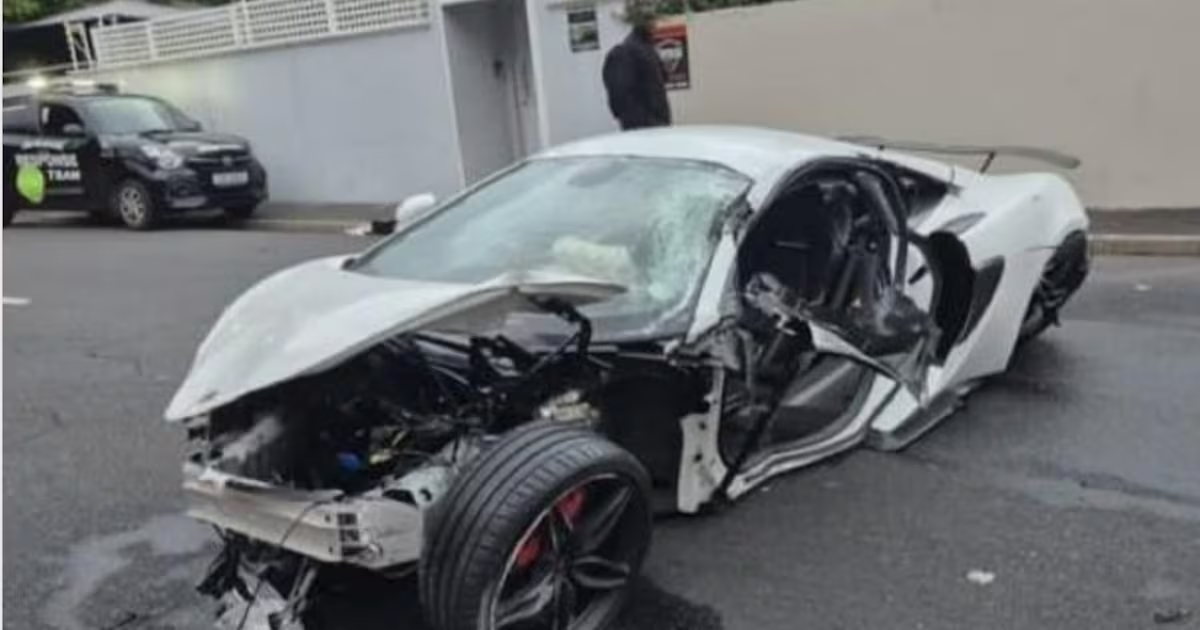
South Africa bears a serious stigma of disgrace: it has the highest annual number of road deaths on the African continent. At the heart of the crisis is speeding, which steals response time, increases the number of crashes and leaves drivers paying long after debris is cleared.
Ombudsman Edit Teixeira-McKinnon, head of the non-life insurance division at the National Financial Ombuds Scheme South Africa (NFO), said with every collision resulting in higher repair costs, insurers essentially pass on the burden through rising premiums.
“What's worse is that when speeding is found to be the cause of an accident, insurers often resort to the 'reasonable care' exclusion to deny claims outright. This clause requires policyholders to act reasonably to prevent loss and damage.”
However, some policies go even further, excluding cover when the driver exceeds the speed limit by 20 km/h, he said. Unlike the broad “reasonable care” clause, which is more common in short-term insurance policies, this exclusion must be highlighted to policyholders before inception.
A driver who traveled at 114km/h in a 60km/h zone had his claim rejected. The insurer cited the “exceeding 20 km/h” policy exclusion to reject the claim. The insurer relied on data obtained from the vehicle's tracking device. The complainant denied driving 20 km/h over the speed limit and disputed the reliability of the tracking data; However, no evidence was provided to dispute the tracking data.
The complainant could not remember how the accident occurred and speculated that he lost control of the vehicle when he swerved to avoid an object on the road. The complainant was told that to rely on this rejection reason, the insurer only needed to demonstrate what the speed limit was on the road and that the complainant had exceeded the speed limit by more than 20 km/h.
Taking into account the speed limit on the road and the speed at which the complainant was traveling before the accident, the Non-Life Insurance Division was satisfied that the insurer had discharged its responsibility in relation to the reason for denial.
The Ombudsman ruled in favor of a motorist in a case involving the “reasonable care” clause.
The driver said he swerved to avoid the pothole, lost control at the turn and went over the pavement. The claim was rejected based on the following policy exclusion: “You have a duty to take reasonable care to prevent or minimize loss, damage, bodily injury, liability and accidents as if you did not have insurance.”
An accident reconstruction expert found no crater, but calculated that the vehicle accelerated from 61 km/h to 71 km/h while executing the turn, which was above the critical speed of the curve. The insurer argued that this proved negligence.
Teixeira-McKinnon's office disagreed, pointing out that the policy covers reckless driving. To prove negligence, the insurer must show that the driver knowingly or knowingly caused the accident, in other words, that the driver anticipated the possibility of losing control of the vehicle while executing a turn at 71 km/h and that he or she negligently reconciled himself to this possibility.
He argued that mere speed does not equate to negligence. Driving eleven kilometers above the speed limit is not carelessness but carelessness. The insurer was advised to settle the claim and did so.
Times Live