
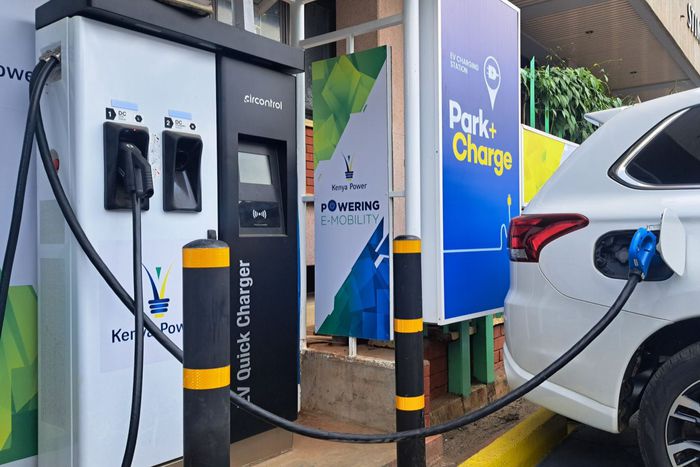
The cost of electric vehicles (EVs) has long seemed to hinder its adoption in Africa. most researchers It was not expected that battery power would become cheap enough to replace petrol or diesel on the continent before 2040.
But falling battery costs, rising global EV production and abundant solar resources are changing that view.
Our new research shows that EVs, especially when combined with off-grid solar charging, could be cheaper than petrol or diesel-powered cars in many African countries in the near future. However, several factors are still limiting the uptake. We argue that financing is a big deal.
We are researchers working on energy policy, life-cycle assessment and low-carbon technologies at ETH Zurich and the Paul Scherrer Institute PSI. Together with African university partners, we have spent the last two years investigating whether African countries can move directly towards electric mobility, bypassing older technology.
This study arose from the need for context-specific evidence to assess whether EVs can play a meaningful role in the transport future of the sector. This could improve local air quality and also change the emissions trajectory of one of the world's fastest growing transportation sectors.
The main challenge is not whether electric mobility makes sense technically for the African context – but rather how to finance it at scale.
High interest rates, risk premiums and limited access to long-term loans still make electric vehicles unattainable for most Africans. But in low-risk countries like Botswana, Mauritius and South Africa, financing conditions today are already close to making costs the same for electric and fossil fuel cars.
Our research shows that if an EV is purchased cash upfront excluding taxes, it will already be cost-competitive in some scenarios.
Unlocking the accelerated growth of EVs in Africa requires focused research on scalable financing solutions. We outline four points potentially relevant to researchers, African policy makers and international finance institutions.
Reducing financial risks along with indirect public subsidies
Africa's EV market is growing rapidly, reaching US$17.4 billion in 2025 and is expected to reach US$28 billion by 2030, although it currently accounts for less than 1% of the total on-road vehicle fleet.
Our research looks at the total cost of ownership competitiveness of EVs in 52 African countries across six passenger vehicle segments: small and medium two-wheelers; small, medium and large four-wheelers; and a minibus section. We also looked at three time frames: 2025, 2030, and 2040.
We found that in more than half of the countries examined, financing costs for EVs would need to fall by 7-15 percentage points to reach cost parity with conventional vehicles by 2030. This drop can reduce lifetime financing expenses by thousands of dollars, often enough to move a vehicle from unaffordable to firmly within reach.
Technology risk is no longer a problem: EVs are now commercially mature and are increasingly being used around the world and in Africa.
Country-specific risks are more of a problem. This reflects a number of perceived or actual investment risks such as macroeconomic or institutional instability, currency instability, or unfamiliarity with EV business models among lenders, resulting in inflated purchase prices.
Indirect subsidies such as tax or import duty exemptions for EVs are helpful and popular in many African countries.
But to accelerate and sustain EV adoption, countries may also need instruments that transfer financial risk from private lenders to public actors. This may reduce the overall price of the vehicle.
These instruments may have credit guarantees, concessional loans and mixed finance structures. In practice, this means that governments or other public financial institutions will absorb some of the risk associated with EV loans.
This will make lenders feel more comfortable financing EVs. By absorbing some of the risk, these instruments could reduce interest rates to levels that make EVs more affordable – accelerating adoption and shortening the window where public subsidies are needed.
EVs as financial assets
EVs are suitable for reducing risk. Cars and charging systems are standardized assets with predictable cash flows. Loans can be bundled and securitized, meaning that individual vehicle loans are pooled together and converted into tradable financial products.
The same thing happens with mortgages, but not with most infrastructure projects. In this sense, EV financing may be simpler and more scalable than traditional development finance.
Packaging thousands of small EV loans into investable products could attract pension funds, insurers and impact investors – a capital pool far larger than traditional development assistance.
Multilateral development banks play an important role here not as primary lenders but as market makers. By helping structure financial products, setting standards, and offering partial guarantees, they can mobilize private capital on a large scale.
Public financing to strengthen private sector momentum
Private companies are already proving that electric mobility can work in low-risk African markets.
In Kenya and Rwanda, companies offering battery-swapping, leasing and pay-as-you-go models for electric two-wheelers and three-wheelers are expanding rapidly. These business models reduce upfront costs for consumers and generate operating data that instills confidence among investors.
The opportunity now is to secure public funding to build on these early successes. Private companies can bundle vehicle loans and charging assets into regional portfolios, spreading risk across countries and customer regions.
Once these portfolios are established, public actors, such as development banks or climate funds, can enhance them, especially in high-risk markets. For example, they could help create pan-African EV financing platforms that channel capital smartly across high- and low-risk environments.
EV policies and country-specific financing terms
Financial de-risking efforts for EVs in Africa should be developed alongside a comprehensive EV policy. Clear, predictable national policy frameworks can reduce investment uncertainty and directly reduce financing costs.
Kenya's National Electric Mobility Policy is a prime example. Apart from offering incentives to increase EV adoption, the policy strengthens the regulatory framework and supports the expansion of charging infrastructure. It also encourages local EV manufacturing and assembly, potentially helping to create opportunities for green economic growth.
This doesn't mean every country will need aggressive EV mandates tomorrow. Within the continent, there are strong inter-country differences in both financing requirements and policy environments for e-mobility. Some countries may require more public intervention than others.
Effective policy measures may include:
- temporary import duty exemption
- Targeted purchase incentives for low-income buyers
- fuel tax reform
- Clear strategies for phasing out high polluting used vehicles.
Policies should be reviewed timely and regularly, thereby avoiding long-term fiscal burden as EV prices naturally fall.
Targeting incentives toward smaller, mass-market vehicles could also improve equity. This will ensure that public support benefits first-time buyers rather than wealthy households.
The evidence is clear, Africa does not need a technological breakthrough to electrify passenger transport. It requires cheap capital and a supportive policy environment to accelerate EV adoption.
Christian Moretti, Senior Researcher, Paul Scherrer Institute PSI, Swiss Federal Institute of Technology Zurich and Bessie Knoll, Senior Researcher, Swiss Federal Institute of Technology Zurich
This article is republished from The Conversation under a Creative Commons license.