
-
French and African investors announced a combined commitment of 23 billion euros ($27 billion) during the Africa Forward summit in Nairobi.
-
French President Emmanuel Macron said the French component of the package could create 250,000 direct jobs in Africa and France.
-
Proparco signed deals worth more than €500 million in Nairobi, including major agreements with Ecobank, BOAD and Axion.
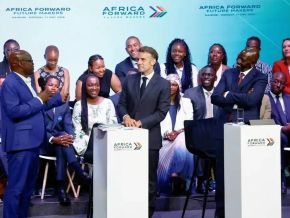
French President Emmanuel Macron finally announced investment commitments of 23 billion euros ($27 billion) for Africa. “Inspire and Connect” Business Forum, which opened the Africa Forward Summit, co-hosted by France and Kenya in Nairobi.
Diplomats and investors focused on the scale of the commitments, although the ultimate test will depend on how quickly investors deliver the funds.
The forum initially targeted 2,000 to 2,500 business leaders. However, organizers said the University of Nairobi event was attended by about 7,000 participants. Participants attended 32 panels across four thematic forums and over 700 business meetings.
The investment package consists of two components. French companies, ranging from large corporations to medium-sized firms and SMEs, pledged 14 billion euros. African entrepreneurs and investors announced an additional 9 billion euros of investment across the continent in conjunction with the event.
Macron said the French share in the investment should support the creation of 250,000 direct jobs in Africa and France.
Proparco Anchors Financing Drive
Proparco, the private sector financing arm of the French Development Agency (AFD) and co-organizer of the Forum, formed the financial backbone of the initiative.
The institution said it signed agreements worth more than 500 million euros in Nairobi through 11 transactions, almost half of its annual African commitment volume.
Two transactions dominated the package. Proparco signs a 300 million euro, three-year protocol agreement with Ecobank focused on agricultural value chains. The institution also completed a €200 million cross-currency euro/CFA franc transaction with the West African Development Bank, which officials said was a world first.
In addition, Proparco agreed a partnership with AXIAN worth 300 million euros over three years. The lender also provided a $20 million loan to South African vaccine maker Biovac and signed agreements with SETRAG, Equity Group, CRDB Bank, Atlantic Group and Corridor.
In addition, Proparco launched the Africa AgriTrade alliance, which brings together 16 financial institutions with combined balance sheets of close to EUR 400 billion. The alliance aims to address Africa's $50 billion agriculture trade finance gap.
“500 million euros in a single day,” said Francois Lombard, chief executive of Proparco.
First Africa-France summit outside the Francophone region since 1973
The summit marked the first time since 1973 that the Africa-France format was held in an English-speaking African country.
The choice of Nairobi reflects an effort by the French presidency to move beyond its traditional Francophone sphere of influence as France reduces its military presence in the Sahel and faces growing opposition to its influence in West Africa.
Kenya, which promotes itself as the “Silicon Savannah” and signed a defense pact with France in April, has emerged along with Nigeria as a central pillar of France's diversification strategy towards anglophone and fast-growing economies.
Nigeria sent a high-profile trade delegation to Nairobi that included Aliko Dangote, Abdul Samad Rabiu and Tony Elumelu.
During his speech, Macron acknowledged that French companies have lost market share to China, Türkiye, the United States and many African competitors. He attributed the decline partly to the decade during which some French administrations and corporations behaved as if they were operating on a guaranteed territory.
“€23 billion investment announced for the continent,” Macron praised companies including Orange, Canal+, bioMérieux and Castell.
Macron framed the summit as part of a decade-long reframing of France's relations with Africa around “co-investment” and “equal partnerships” rather than the top-down approach associated with previous summits.
Critics question depth of policy change
However, critics challenged the extent of the strategic change. Togolese economist Kako Nbukpo said the transition is incomplete.
“The imperial economy is still there,” Nbukpo told France 24, citing the continued use of the CFA franc and the lasting influence of groups such as Bollore, Vinci and Efage in Francophone Africa.
Restoration efforts have also faced setbacks. Maritime group CMA CGM announced a €700 million investment in the Mombasa port terminal. However, Kenya canceled a $1.5 billion highway expansion contract awarded to a Vinci-led consortium in 2025 and instead selected Chinese companies for the project.
The comprehensive investment package adds to the existing bilateral economic foundation highlighted by the French President. France and Africa currently generate 64 billion euros in annual trade, while France's direct investment stock in Africa totals 50 billion euros. French subsidiaries support approximately one million jobs across the continent, and the African diaspora sends approximately 5 billion euros in remittances annually.
Meanwhile, France's financial climate has intensified scrutiny of the initiative. France's official development aid budget has suffered five consecutive cuts in less than two years. Parliament approved 3.5 billion euros in payment appropriations for 2026, 18% below 2025 levels and more than 2 billion euros below 2024 levels.
As a result, total French development assistance in 2026 could fall to 0.38% of gross national income, well below the 0.7% target established under the 2021 law that France has effectively abandoned.
Fiacre E. Kakpo