
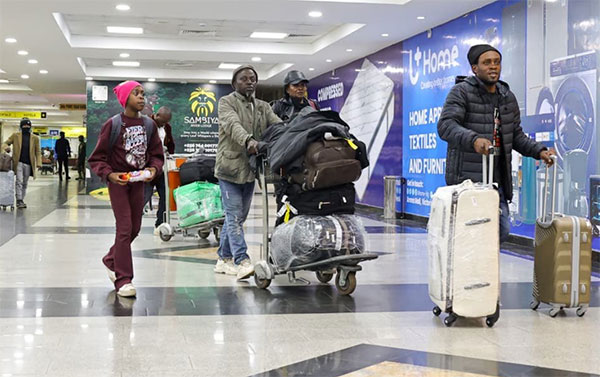
Comment | Katuribe of Obed Unfortunately, South Africa is in the news for all the wrong reasons. Imagine black Africans chasing down and beating to death fellow Africans who were seeking economic fortune outside their country.
For some time, South Africa has been the number one economy in Africa due to its highly diversified GDP, world-class financial sector, abundant mineral resources and advanced infrastructure. As a result, many expatriate Africans went to South Africa and tried their luck in that larger economy. They went there either as professionals who were desperately needed by the new post-apartheid government or as entrepreneurs looking to take advantage of this large and vibrant economy.
The Africans who are being hunted and pursued do not necessarily work in government structures. They are vibrant businessmen and women who have become so successful, hence attracting the envy of 'sleepy' South Africans. Now they are being hounded by indigenous vigilantes, all the while making nasty nationalist rhetoric, to steal their hard-earned property.
Diaspora Africans went to South Africa with a high sense of innovation, which is in contrast to the general mindset of South Africans, who are still enamored with welfare freebies from their government. As a result, this has forced many South Africans to lag behind in this area gambling black Business and Entrepreneurship. Even if they succeed in driving out all the migrant Africans from their lands, it will not make them rich because whatever they grab from the fleeing neighbors will not last because they have not built it.
Something similar happened in Uganda in the early 70s when the then Ugandan President Idi Amin nationalized Indian businesses and drove them out of Uganda and handed over their businesses to Ugandans. As expected, the Ugandans shot them down, and the economy subsequently collapsed with civilian losses.
The creativity and entrepreneurship of non-citizens in any country should never be seen as a hindrance to the natives. On the contrary, it should be seen as knowledge freely transferred to indigenous peoples, so that they can improve their own skills and innovations for the complete transformation of their own communities.
Anti-immigrant violence and hostility by black South Africans against other black African citizens is primarily driven by severe socioeconomic conflict, high unemployment, and competition for limited resources. Tensions often peak during economic recessions, allowing deeply rooted xenophobic sentiments.
South Africa continues to struggle with extremely high unemployment rates, particularly in low-skill sectors. Many unemployed locals feel that undocumented immigrants and foreign nationals are taking up the few available jobs, as few employers hire them at lower wages.
Migrants are often used as scapegoats for the country's systemic issues, including an overextended public health care system, inadequate public housing, and local infrastructure failures. Some local and political groups blame foreign nationals for local crime rates, illegal economic activities, and the operation of undocumented businesses in townships and low-income areas.
South Africa is the primary economic hub of the Southern African region, receiving large amounts of legal and undocumented migration from neighboring countries such as Zimbabwe, Mozambique and Malawi.
Therefore, South Africa's problem is what President Yoweri Museveni calls ideological bankruptcy. People who end up creating problems where they never existed. It is important for leaders to always bring the most acceptable and progressive ideology to the people to solve the problems with a transformative agenda.
Indeed, Julius Malema, founder and leader of the Economic Freedom Fighters (EFF), a communist and black nationalist political party, condemned the bankruptcy displayed by his fellow countrymen. He wondered whether expelling fellow Africans, who were all self-employed, was solving the problem of unemployment in South Africa.
Therefore, Africans in rich countries or even poor countries need a national ideology, developed and popularized by all citizens, around which we can utilize all our energies so that our superficial differences (tribe, religion, political persuasion, etc.) do not become points of cleavage but points of strength, what we like to call “unity in diversity”.
At the basic level, all producers of industrial or agricultural goods can survive, grow and develop only in a large market where businesses prosper. When businesses prosper, economies grow. Then, as leaders, we can talk about prosperity and socio-economic transformation becoming a reality and not just a slogan.
Therefore, strategic security, collective bargaining power and a larger market for goods and services at the sub-regional, regional and continental levels become imperative for a Pan-African ideological posture. In this sense, Pan-Africanism and socio-economic transformation are more or less Siamese twins, each a necessary part of the equation of the other.
For now, let us celebrate what has been achieved so far following the struggles that culminated in our political independence, as we move forward to build the ideological radar that will guide Africa in whatever policies we design for our sustainably prosperous future!
****

The author works with Uganda Media Center