
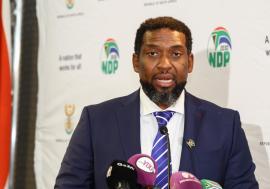
Higher Education and Training Minister Buti Manamela has presented a R149.2 billion budget for what he described as a “skills revolution”, which aims to strengthen the link between education, work and industrial growth.
The department's budget vote, tabled in Parliament on Tuesday, aims to boost digital transformation, expand technical and vocational training and reposition South Africa's post-school education and training system to respond more directly to employment and economic needs.
Manmela stressed that the budget must become more than a budget of devolution, but a budget of “transformation, coordination, skills, accountability and results”.
The department's allocation for the 2026/27 financial year increases to R149.2 billion from R142.4 billion in 2025/26, while total spending on the medium-term expenditure framework is estimated at R468 billion.
Transfers and subsidies amount to R134.9 billion or 90.4% of the total allocation.
Universities remain the largest component of the budget, receiving R100.1 billion, representing approximately 82.4% of the program budget.
Technical and vocational education and training (TVET) colleges get R14.7 billion, representing an increase of 6.3% as the government steps up efforts to establish TVET institutions as hubs for vocational and technical skills development.
Community education and training (CET) colleges receive R3.3 billion, which Manamela acknowledged highlighted the structural shortcomings of the sector.
Manmela said TVET and CET colleges are still low relative to the size of the country's population and the demands of its economy.
The Minister said, “TVET is central to the production of mid-level technical and vocational skills. CET provides a second chance that reconnects young people and adults to the education and training system. Both must grow – and both must improve.”
The Minister announced that the National Student Financial Aid Scheme (NSFAS) is projected to increase from R48.8 billion in 2025/26 to R54.6 billion by 2028/29, with Skills Levy income projected to increase from R27.7 billion in 2026/27 to R31.1 billion by 2028/29.
Manmela said the budget priorities are focused on three strategic areas, including digital transformation, skills revolution and reshaping the size and structure of the post-school education and training system.
He announced plans to expand online and digital learning platforms, modernize data systems, launch online TVET and CET offerings, and strengthen digital career guidance services.
The department also plans to deepen investments in artificial intelligence, software development, cyber security and data-related skills through partnerships with leading technology companies.
“The real question is whether the system can plan, teach, track, fund, and connect people to opportunity at the speed and scale it needs,” Manmela said.
The minister said the “skills revolution” will focus on vocational qualifications, apprenticeship and artisan development, workplace-integrated learning, regional industrial skills compacts and employer partnerships.
Stated goals included the establishment of five regional industrial skills compacts, employer partnership agreements through Sector Education and Training Authorities (SETA), and increased artisanal and vocational skills training.
Manamela said the government is finalizing the university enrollment plan for 2025 to 2030, developing a five-year TVET enrollment plan, auditing the CET scenario, and continuing work on new institutions, including the proposed Ekurhuleni University and new medical and veterinary schools.
“We are converting agricultural colleges into higher education colleges, and we are addressing student housing and infrastructure as a prerequisite for any meaningful expansion.”
He stressed that the effectiveness of the budget would ultimately be judged by whether it improved opportunities for youth.
“The test of this budget vote is not whether the department spends. The test is whether a young person in Mitchells Plain, in Giyani, in Rustenburg, in Lusikisiki, in Kuruman, in Mdantsane, or in Soweto can see – and walk – the path from learning to livelihood,” Manmela said. – sanews.gov.za