
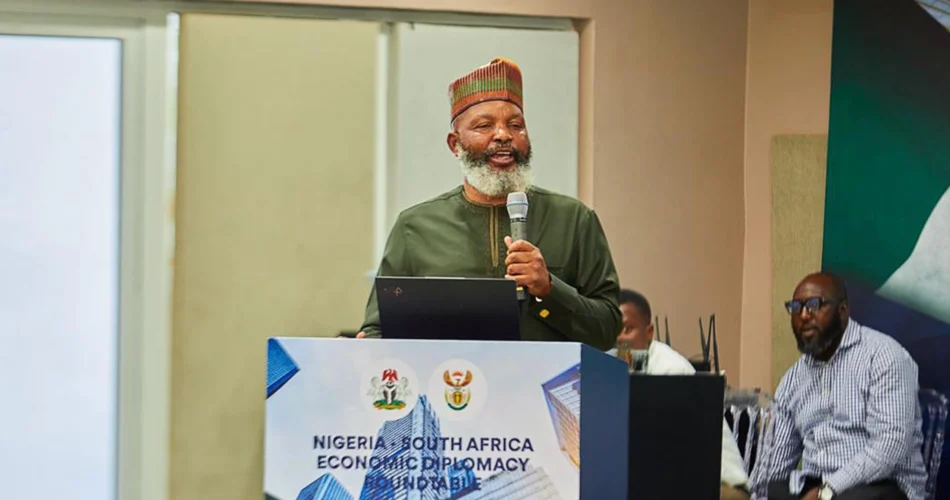
Kelvin Fiume is Director of Africa Bilateral Economic Relations at the South African Department of Trade, Industry and Competition (DTIC). An experienced trade diplomat, he speaks with ISAAC CHIBUIFE on implementation, efforts to strengthen trade and investment relations between Nigeria and South Africa African Continental Free Trade Area (AfCFTA)Repeated tensions over visa concerns and xenophobia at South Africa's Independence Day celebrations, organized by the South African Consulate General in Lagos.
What is the significance of South Africa's Independence Day organized by the Consulate General in Lagos? What has been the focus of your engagements so far?
We are celebrating South African Independence Day through a series of activities organized by the South African Consulate General office here in Lagos, where we will hold an official ceremony to mark what South African independence means to us as a nation. We were also joined by the Deputy Minister of the Department international relations and cooperation, Thandi Moraka, who led a business delegation. We held a number of meetings with the Nigerian private sector to strengthen trade and investment relations between the two countries and gain a clear understanding of the challenges faced by Nigerian businesses trying to enter the South African market.
Beyond engagements, how can we deepen bilateral trade and investment between South Africa and Nigeria, given that many South African companies are metric tonn, multiple choice And Standard Bank Already have a presence here?
The two countries enjoy very good relations and there is a genuine commitment on both sides to promote trade and investment relations. However, Nigeria faces massive economic challenges that are beyond its capacity federal governmentt alone. They are, in part, global in nature.
Foreign Exchange (FX)) is an issue we hear about constantly; Some South African companies are unable to return their returns because Central Bank of Nigeria (CBN) There may not be enough liquidity. Equally, companies that have invested here and need to procure certain products outside Nigeria find the FX allocation process a significant hurdle. But these are challenges that both governments are actively working on together. Building on South Africa's manufacturing capabilities, we believe we can provide real value in helping the Nigerian private sector navigate and thrive in this environment.
Most observers argue that implementation of the African Continental Free Trade Agreement (AfCFTA) has been sluggish. Given that both Nigeria and South Africa have ratified the Agreement, what concrete steps can be taken to accelerate its full implementation?
53 out of 54 countries – if we exclude Eritrea, which has not yet fully ratified – all other African countries have ratified the agreement. The important next step for governments is to domesticate it by incorporating it into their domestic laws.
Currently, only 23 countries have done so and we strongly encourage others to follow suit so that we can introduce preferential trade within the framework. I am happy to say that both South Africa and Nigeria have already completed this process. South Africa gazetted the agreement on January 31, 2024, while Nigeria followed on April 15, 2025. This means that South Africa and Nigeria can, right now, start exploring the preferential trade opportunities afforded to us by AfCFTA, as we are both fully operational members of the agreement.
South Africa is said to have eased visa restrictions for Nigerians. Nevertheless, Nigerian business travelers continue to complain about difficulties in obtaining visas. What is your response to those concerns?
It is a misconception that the South African High Commission or Consulate General refuses to issue visas to Nigerian citizens. This is not accurate at all. There are certain rules and regulations that must be followed, and if Nigerian business travelers comply with those requirements, they will have no difficulties in obtaining their visa. The issue is that many people choose to use travel agents rather than applying directly. Unfortunately, those agents sometimes submit fake documents.
For example, I know of cases where a prominent Nigerian businessman surrendered his passport to an agent without providing the necessary supporting documents such as bank statements. The agent then fabricated those statements. When our consular officers verified and contacted the bank, the data did not match, and the application was rejected – that's right. The real solution is education: Every Nigerian citizen must understand that they are responsible for submitting their own genuine documents, not documents produced by third parties.
Over the past few years, Nigeria–South Africa relations have been strained due to trade disputes and repeated reports of foreign attacks against Nigerians living in South Africa. How do you respond to those allegations and what is the government doing to address them?
South Africa is not a xenophobic country. What you see reported are isolated incidents that are routinely misrepresented. When South African law enforcement agencies carry out their lawful duties, some Nigerian citizens in South Africa take to social media to portray their actions as targeted attacks, which is not the case. If you consult the Nigerian High Commission in Pretoria or the Nigerian Consulate in Johannesburg, they will tell you clearly what the real issues are.
There are groups of Nigerian citizens in South Africa who have organized themselves into factions and are engaged in territorial disputes among themselves. these are not xenophobic attacks By South Africans against Nigerians. South Africa is very open to legal Nigerian investment and those who conduct themselves within the law face no difficulties. What we find troubling is the coordinated media narrative – sometimes the same story, the same words, appearing simultaneously in multiple media outlets, which appears designed to damage the strong trade and investment ties between the two countries. There is no enmity of any kind at the political level. We have presidential level engagement and a strong Joint Ministerial Advisory Council on Industry, Trade and Investment between ministers of the two countries, reporting directly to both Presidents under the South Africa-Nigeria Binational Commission.
What is the long-term vision for Nigeria-South Africa cooperation, especially in the areas of infrastructure and economic development?
Whatever we are doing here will be informed to both the heads of state. This is not a one-time event – we will be back next year, and the partnerships will be even more concrete. South Africa and Nigeria are the two largest economies in Africa. The possibilities are immense if we collaborate on joint projects while identifying complementarities between our sectors. In terms of infrastructure, South Africa has world-class development finance institutions – the Development Bank of Southern Africa, the Industrial Development Corporation, the Public Investment Corporation and the Export Credit and Insurance Corporation – which together form what we call South Africa Inc., which provides financing for infrastructure and a wide range of sectors including automotive, agriculture, agro-processing, manufacturing and pharmaceuticals. Our goal is to build shared value chains in these sectors so that both Nigeria and South Africa can fully utilize the opportunities presented by AfCFTA, not only for our two countries, but for the entire continent.