
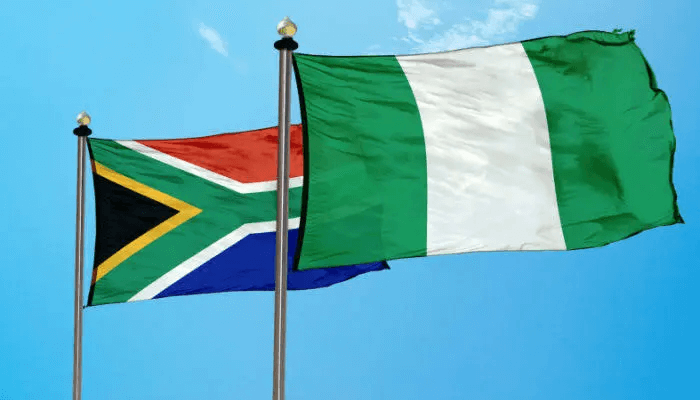
The 2025 economic relationship between South Africa and Nigeria has emerged as one of Africa's most strategically important partnerships, with bilateral trade topping $2.16 billion despite a major trade deficit for the southern African nation.
New data released at the end of the fourth edition of South Africa Week held in Lagos showed that the country exported $468.48 million worth of goods and services to Nigeria last year, while importing $1.69 billion – resulting in a deficit of $1.22 billion.
The event, organized by the South African Consulate General in Lagos in partnership with Brand South Africa and the Development Bank of Southern Africa (DBSA), is a strategic initiative that aims to promote social cohesion between South Africans and Nigerians, while positioning South Africa as a preferred destination for business, tourism and education.
“The 2025 economic relationship between South Africa and Nigeria reflects a strategically important, multidimensional partnership based on trade, energy security, investment flows and strong institutional cooperation.
“While bilateral trade remains structurally unbalanced – South Africa exports US$468.48 million and imports US$1.69 billion, resulting in a deficit of US$1.22 billion – this dynamic is largely driven by South Africa's dependence on Nigerian crude, positioning the relationship as one of strategic interdependence rather than mere imbalance.
“This partnership is further enhanced by the relative economic weight of both countries,” a statement from organizers said.
According to International Monetary Fund (IMF) projections, South Africa's economy is worth about $443.6 billion for 2026, while Nigeria's nominal economy is about $334.3 billion.
As the continent's two largest economies, their bilateral engagement is a central axis of African economic activity, with a disproportionate impact on the success of continental integration efforts.
Beyond trade, the statement said the relationship is strengthened by deep two-way investment ties – South African companies – including MTN Group, Shoprite and Standard Bank – maintain a strong presence in Nigeria, while Nigerian companies such as Access Bank and Paystack have established a growing presence in South Africa.
Although investment flows were uneven and some Nigerian companies faced operational challenges, organizers said these exchanges reflect an emerging bi-directional economic corridor that extends beyond goods trade to services, finance and digital innovation.
In line with Brand South Africa's mandate to build the country's global reputation and competitiveness, the week-long event will involve leaders from government, business, civil society, academia and media.
Meanwhile, South Africa is replacing Nigeria as its primary source of crude oil imports amid rising geopolitical tensions in the Middle East.
Director, Africa Bilateral Economic Relations, Department of Trade, Industry and Competitiveness, South Africa, Mr. Kelvin Fuame disclosed this at the South Africa Energy Week 2026 in Lagos, themed: “Restoring and Promoting Energy Investment between South Africa and Nigeria”
Fuame said the transition to refined products handled by the Dangote Refinery was already underway.
“Because of America's Israel-Iran war, there are discussions that most of our oil will come from here (Nigeria). But the discussions are at the highest level.
“We get huge quantities of refined petroleum oil. So, it is because of the Dangote Refinery. It is helping us a lot in South Africa and the whole continent,” he said.
He said bilateral trade between Africa's two largest economies has increased since Nigeria gazetted its provisional schedule of tariff concessions under the African Continental Free Trade Area (AfCFTA) on April 15, 2025.
“You would recall that I indicated last year that Nigeria would gazette its provisional schedule of terminal concession of AfCFTA on April 15, 2025. Therefore, we were able to add Nigeria to the list of countries that will benefit under AfCFTA in August last year.
“So, from then until now, we have seen a huge increase in trade between South Africa and Nigeria, but now it is heavily tilted towards South Africa”, Fuame said.
He said that between 2023 and 2025, South Africa's exports to Nigeria are expected to increase by 24 per cent from $355 million to $442 million.
Fumé said exports in the past year alone rose 16 percent to $380 million in 2024, “which can be attributed to the increase in goods vehicles and fresh apple exports.”
According to him, in 2025, South Africa's top exports to Nigeria included freight vehicles, fresh apples, polypropylene, aromatic substance mixtures and food preparations.
“Iron and steel, because of our industrial economy, we are able to manufacture the pipes we need for oil in Nigeria. So, it is number three. And we also make some diversified chemical products which are very important in the Nigerian market”, Fuame said.
In contrast, South Africa's imports from Nigeria are projected to fall 33 percent between 2023 and 2025, from $2.3 billion to $1.5 billion.
“This can be attributed to a decline in Nigeria’s total crude oil exports in 2025,” he said.
Despite the decline, he said crude oil remained dominant, pointing out that in 2025, South Africa's top imported products from Nigeria were petroleum crude oil, urea, refined petroleum oil, natural rubber, aluminum containers and aeroplanes.
He said AfCFTA has reshaped the trade balance between the two countries, eroding Nigeria's historical advantage in crude oil shipments.
Fuame said: “Earlier, it was very skewed to Nigeria because of crude oil. But since we started trading under AfCFTA, number one is oils and seeds, and oligosaccharides, fruits, nuts, grains, seeds, fruits, industrial and medicinal plants, straw and fodder,” Fuame said.
“While Nigeria normally enjoys a trade surplus, its trade with South Africa under the AfCFTA priority is significantly tilted in favor of South Africa.
“Both countries will need to step up their efforts to encourage and support value-added exports under the AfCFTA and maximize new markets.”
In his keynote address, the Deputy Minister of International Relations and Cooperation of South Africa; Ms Thandi Moraka stressed the importance of strategic cooperation between Nigeria and South Africa to catalyze production and promote investment in energy infrastructure to guarantee energy security for their citizens.
He pointed out that a remarkable example of Africa's potential lies in the energy and industrial development demonstrated at the Dangote Refinery.
According to him, as one of the largest oil refineries in the world, Dangote Refinery is an important player in the Nigerian oil and gas industry.
He said the refinery is not only a program that benefits Nigeria by reducing dependence on imported petroleum products but also positions Africa as a key player in the global energy market.
“In the context of our current geopolitical tensions, ever-changing energy insecurities, such as the ongoing war in the Middle East and its adverse impact on global oil and gas security, the Dangote Refinery offers a strategic advantage to the African continent and Nigeria as a country.
“It therefore enhances Africa's energy security and also provides a buffer against global supply disruptions and helps us create opportunities for regional integration at an economic level.
“We need to start working towards scaling up these types of initiatives across the African continent,” Moraka said.
He noted both countries as powerhouses on the African continent, each of which has immense potential to drive sustainable development, economic growth and regional integration through strategic energy cooperation.
“We know that Nigeria plays an important role within the West Africa region and South Africa plays an equally important role within the Southern African Development Community, which is the SADC region.
Moraka said, “As we all know that energy is the backbone of every development, we need to focus on a reliable, affordable and most importantly sustainable energy access that can help us unlock opportunities across industries and also help in empowering communities and enhancing the good quality of life for our citizens.”
He said South Africa and Nigeria are among the top three largest economies on the continent that have made significant progress in expanding their energy sectors.
However, he pointed out that challenges such as lack of infrastructure, grid instability and dependence on non-renewable energy sources continue to hinder their full potential.
Moraka said, “There is a need for a strategic shift in the process of repositioning our energy investments, with emphasis on the issues of regional economic integration and innovation capabilities of our beautiful countries. We need to work with Nigeria with its solar potential and with South Africa with its wind and solar capabilities towards having abundant renewable sources that can be used to diversify energy resources.”
Peter Uzoho
What should I follow: