
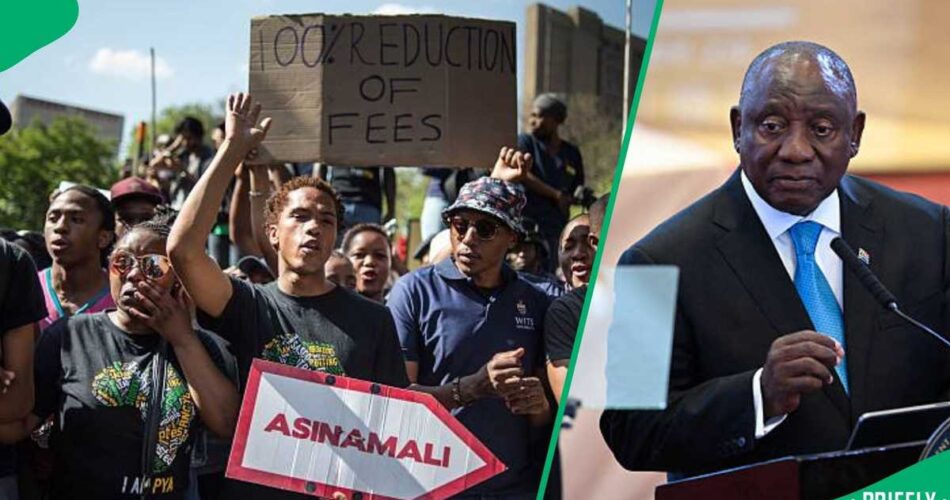
- President Cyril Ramaphosa's 2026 State of the Nation Address promised growth and reform, but offered no clear plans to address financial exclusion in universities.
- Research shows that financial hardship hurts academic performance, more than 110,000 eligible matriculants lack placement, and many enrolled students face barriers due to historic debt
- Ongoing challenges to the National Student Financial Aid Scheme and criticism of Finance Minister Enoch Godongwana highlight a deep higher education funding crisis
Source: Getty Images
South Africa– President Cyril Ramaphosa's 2026 state of the nation address (Gold) projected optimism: economic recovery, infrastructure expansion and long-term growth. But for thousands of students blocked from registering because of unpaid fees or incomplete funding, the speech offered little reassurance.
What was conspicuously absent was a clear, time-bound plan to tackle financial exclusion in universities, an issue that is derailing academic careers across the country.
Admission without funding is a broken promise
South Africa An 88% matriculation pass rate was celebrated in 2025, with 345,857 learners qualifying for graduation. But public universities can only accommodate 235,000 first-year students. This has left more than 110,000 academically qualified youth without placement.

Even for those who secure admission, registration barriers associated with historical debt prevent many from continuing their studies.
Financial exclusion is not a side issue
a fresh Peer-reviewed studies at Mangosuthu University of Technology (MUT), led by Dr. Sibonelo Thanda Mbanjwa, confirms what student movements have argued for years: financial hardship directly undermines academic success.
The cross-sectional study surveyed 220 undergraduate students, yielding a 90% response rate. While 61% were fully funded by the National Student Financial Aid Scheme (NSFAS), 39% were either partially funded or self-funded – effectively operating at the margins of exclusion.
nsfas dilemma
The funding crisis is further complicated by governance concerns. South Africa is spending R700 million on NSFAS administration, this money is not given directly to students.
finance minister Enoch Godongwana has publicly questioned the value of the institution As an administrative body, arguing that inefficiencies undermine its core mandate.

Speaking at a post-Budget event, he said the country was spending Rs 700 million on administration alone, arguing that the fees of about 9,000 students could be covered with this amount.
Godongwana explained that although student funding is essential, the institution itself suffers from mismanagement, leadership instability and reliance on external service providers to carry out its core functions.
“Economic apartheid” at the door
news in brief contacted by economic freedom Fighters Youth Command, who described the situation as “economic apartheid by other means”, arguing that universities are reproducing inequality by denying access to economically distressed but academically capable students.
Its demands include immediate registration for students with historical debt and a permanent national debt cancellation framework. Universities routinely withhold registration and academic transcripts over outstanding balances. For working-class students, historical debt becomes a multi-year barrier to completion and employment.
human cost
news in brief Spoke to Zama Mkhize, a former student enrolled at the university KwaZulu-NatalWho knows this reality directly. Her parents did not qualify for NSFAS aid, but they also could not afford the tuition. She did not meet the strict academic requirements required for private scholarships.

read this also
“It's very sad”: King David Victory Park closed despite 100% graduation matriculation
“We were able to register and pay for the first term, but as the years went by, the financial situation became difficult, until I was forced to leave school due to non-payment,” she explains.
Despite the failure, he has not given up on his dream of earning a psychology degree.
“I thought if I could get a job and have savings, one day I would be able to go back and fulfill my dream.”
a generation in danger
The paradox is stark: the government celebrates improved matriculation results and youth potential, yet fails to guarantee sustainable participation in higher education.
Yet SONA 2026 did not outline a comprehensive student loan framework, nor did it signal structural reform of university funding. This silence suggests that financial exclusion is not being treated as a macroeconomic risk, despite its direct impact on human capital development.
Every student who drops out represents lost public investment and a reduction in future earning potential for the economy.

Source: Getty Images
3 articles on student loans
Source: News in Brief