
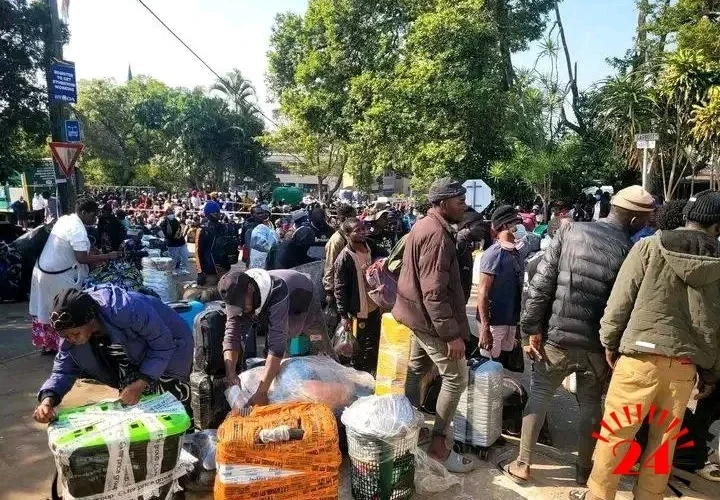
The large-scale repatriation of Malawian citizens from South Africa has sparked debate over whether responsibility lies with the Government of Malawi, the Government of South Africa, or both.
An objective assessment suggests that the issue is driven by a combination of economic migration, immigration enforcement, labor market pressures, and humanitarian concerns, rather than the actions of any one government.
Recent reports indicate that over 38,000 Malawians have been processed for repatriation from South Africa during recent operations.
Many returned voluntarily through assisted repatriation programs, while others were deported after being found without valid immigration documentation.
Large numbers of undocumented Malawians fled their workplaces and residences following anti-illegal immigration campaigns, protests, and fears of arrest or deportation.
Many reported concerns about intimidation, xenophobic and Afrophobic attacks, harassment, loss of employment, lack of access to food, and uncertainty about their legal status.
Others sought temporary refuge at Malawi's diplomatic missions or designated assembly points while awaiting repatriation.
Human rights organizations have repeatedly called for migrants to be protected from violence regardless of their immigration status.
Sadly, reports from temporary repatriation centers in Sherwood and Musina describe overcrowding, inadequate shelter, limited sanitation facilities, lack of food and bedding, and long waiting periods before being taken home.
Such situations have increased humanitarian concerns.
Although governments face logistical challenges during large-scale repatriation exercises, international human rights principles require that all people – including undocumented migrants – be treated with dignity and provided with basic necessities.
It is important to understand that economic factors remain the major reasons why many Malawians migrate to South Africa.
Adverse conditions in Malawi include high unemployment, low wages, limited industrial development, poverty, currency instability, and the search for better educational and occupational opportunities.
In fact, South Africa's comparatively large economy has historically attracted immigrants from throughout Southern Africa, including Malawi.
Migration issues are therefore not new in South Africa. He was there during the apartheid era. He was there during the Nelson Mandela regime. They are still there.
However, while the motivation to leave one's country for better opportunities is understandable, entering or remaining in another country without legal documentation is a violation of immigration laws.
Therefore, on a humanitarian and Ubuntu perspective, economic reasons are reasonably compelling, but they do not exempt migrants from following legal immigration procedures.
It has been observed that some anti-illegal immigration groups argue that undocumented foreign nationals reduce employment opportunities for South Africans.
However, there is currently no conclusive evidence demonstrating that the number of Malawian or other undocumented migrants deported directly corresponds to the corresponding number of jobs created for South African citizens.
In fact, labor market outcomes are influenced by many factors, including economic growth, investment, skills shortages, business confidence, and macroeconomic policies.
Similarly, there is insufficient evidence to conclude that pursuing or harassing undocumented immigrants creates permanent employment opportunities.
In fact, economists are unanimous that long-term job creation depends primarily on economic expansion, investment, education, industrial growth, and entrepreneurship, rather than just immigration enforcement.
The hard truth is that even though immigration controls improve compliance with labor laws, it is not a comprehensive employment strategy in itself.
Therefore the claim that foreign nationals are largely responsible for various crimes in South Africa is also highly disputed.
Although some undocumented immigrants have been arrested for criminal offences, available crime statistics do not support the conclusion that foreign nationals are responsible for the majority of crimes in South Africa.
In fact, the majority of crimes recorded in South Africa involve South African citizens as they constitute the vast majority of the population.
It is also important to understand that criminal responsibility should be determined individually rather than collectively on the basis of nationality.
Moving forward, both governments have important responsibilities.
The Government of Malawi should strengthen economic growth, create employment opportunities, improve vocational training, promote investment, expand social protection, and improve border management while educating citizens about the risks of irregular migration.
On the other hand, the South African government should continue to fairly and consistently enforce immigration laws, process asylum and work permit applications efficiently, protect all individuals from xenophobic and Afrophobic violence, and ensure that repatriation processes comply with Ubuntu principles and humanitarian standards.
Jointly, the two countries should share intelligence on human trafficking, strengthen legal labor migration routes, improve border management where appropriate, expand bilateral labor agreements, and cooperate on regional economic development through the Southern African Development Community (SADC).
It is hypothesized that large-scale public awareness campaigns that promote legal migration channels as well as discourage irregular migration could also reduce illegal migration in the future.
In conclusion, assigning responsibility solely to Malawi or South Africa oversimplifies a complex regional challenge.
Malawi has a greater responsibility to address the economic conditions that encourage outward migration, while South Africa has the sovereign right to enforce its immigration laws impartially, but also has an obligation to uphold human rights during enforcement and repatriation.
Therefore, sustainable solutions require collaboration between both governments, regional institutions, employers and communities rather than placing blame solely on one party.