
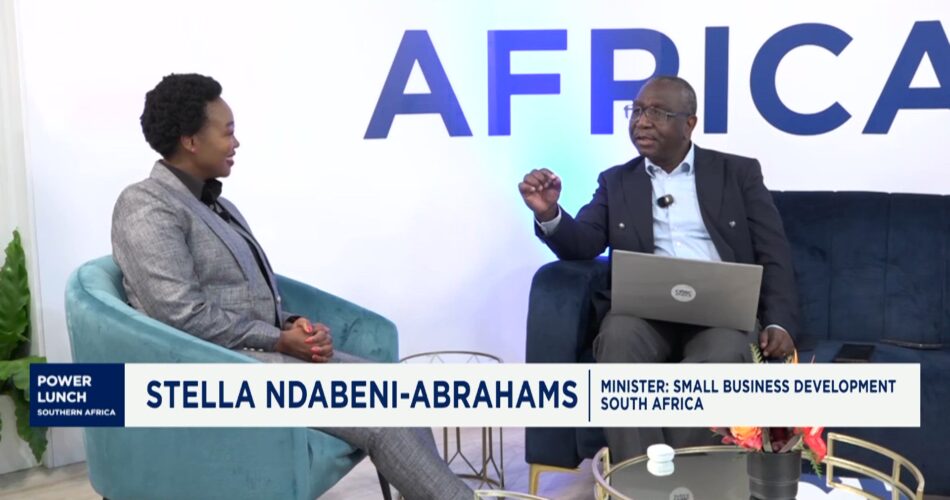
South Africa used its latest investment conference to send a clear message to global investors: The country is moving toward fixing long-standing structural problems, deepening reform efforts and broadening partnership opportunities with the private sector, even as it stands firm on its black economic empowerment framework.
Speaking to CNBC Africa at the sixth South Africa Investment Conference in Sandton, Small Business Development Minister Stella Ndabeni-Abrahams said the government's approach to investors is focused on rapid action, implementation and policy certainty.
His comments came as President Cyril Ramaphosa told conference delegates that investors should evaluate the government not just on its words, but also on whether it is implementing promised reforms. Ndabeni-Abrahams said the tone was important to reassure both existing and prospective investors that South Africa is addressing legacy barriers that have stifled growth and confidence.
“What we are saying to investors is that you have seen us, you have been with us for five years,” Ndabeni-Abrahams said. “People who are coming here for the first time should hear from others … that we are undergoing a number of reforms to address the challenges we face.”
The minister said the government is tackling crime, corruption and infrastructure bottlenecks, while also trying to improve the credibility of the country's institutional systems. He described South Africa's removal from the gray list as evidence that progress is being made to strengthen financial oversight and restore confidence.
According to Ndabeni-Abrahams, Pretoria now wants to work together with private capital to shape the country's next phase of development. Rather than simply asking investors to commit capital, he said the state was looking for long-term partners who could help build productive capacity, support industrial expansion and integrate more South Africans into the economy.
Black economic empowerment remains a major point of friction in discussions with some investors, particularly concerns that compliance obligations could create additional burdens for smaller entrants into the market. Ndabeni-Abrahams acknowledged that there is confusion over the policy, but argued that many concerns are based on a misunderstanding of the purpose of broad-based black economic empowerment, or B-BBEE.
He said the government is unapologetic about regulations designed to uplift and empower local populations, noting that every country has its own policy framework that is shaped by its history and development priorities. In the case of South Africa, he said empowerment policies should be understood in the context of constitutional obligations and the need to address deep economic exclusion caused by apartheid.
The minister stressed that B-BBEE should not be seen as a punitive mechanism that forces investors to give up stake in their companies. Instead, he said it is an incentive-based framework aimed at broadening participation, rewarding compliance and creating benefits for companies that contribute to inclusion through ownership, enterprise development and procurement.
“There are some, not all investors, others understand that every country will have its own rules and policies to uplift and empower the local people,” he said. “It's something we make no apologies for.”
Ndabeni-Abrahams said the government needs to do more to explain the policy in practical terms, especially to investors who believe B-BBEE is little more than a demand for equity transfers. He said authorities were also opening up incentives available to compliant companies, as well as alternative structures such as equity counterparties overseen by the Department of Trade, Industry and Competition.
On the comprehensive reform of the empowerment law, the minister declined to give a specific timeline, saying the process is being led by the Department of Trade, Industry and Competition and requires careful consultation among stakeholders. The debate over whether there should be a “sunset clause” in B-BBEEs has intensified in some circles, but Ndabeni-Abrahams indicated that any such determination would need to take into account the continued need to balance investors' expectations with economic realities, policy outcomes and social redress.
“Don't just be disappointed, you should look at the realities because when you are in government, you strike a balance between what the private sector needs and what the people need,” he said.
He also highlighted the role of enterprise and supplier development as a key part of the empowerment ecosystem. His department is working on an enterprise supplier development policy that will guide how small businesses can be supported, promoted and integrated into corporate supply chains, he said. The goal is to ensure that small companies are not only trained, but ultimately able to access procurement opportunities and sustainable markets.
He argued that this approach is central to building an inclusive growth model in which South Africans benefit not only as employees, but where possible, as business owners.
Beyond the empowerment debate, Ndabeni-Abrahams outlined a number of reform priorities for the period 2024 to 2027, including energy, rail and transport, reducing red tape for businesses and investors, and building domestic manufacturing capacity. He also said South Africa is focused on expanding export opportunities through the African Continental Free Trade Area and other international markets, including Asia.
The Minister reiterated South Africa's position as the gateway to the African continent, with what he described as a strong banking and financial system. He said the government wants to use that platform to attract investment into sectors that can increase production, create jobs and open new markets beyond South Africa's borders.
Still, external risks remain on the radar. Ndabeni-Abrahams said the government is concerned that the war in the Middle East could divert investment flows away from South Africa and the wider African continent. In response, he said officials, in coordination with other government departments and the private sector, are considering mechanisms to provide relief to businesses that may be affected by the fallout.
Acknowledging those geopolitical risks, the minister said South Africa's investment case remains attractive. The government's message, he said, is that the country is confronting the issues that matter most to investors and trying to ensure that the economic recovery is beneficial to its citizens as well.
At a time when investors are demanding delivery rather than rhetoric, South Africa's challenge will be to show that the pace of reform can translate into faster growth, better infrastructure performance and broader economic inclusion. For now, the government is betting that a combination of policy reforms, institutional repair and strategic partnerships will be enough to keep South Africa firmly in the conversation as a leading destination for investment on the continent.