
By Tian Johnson, African Alliance, and Fatima Hassan, Health Justice Initiative
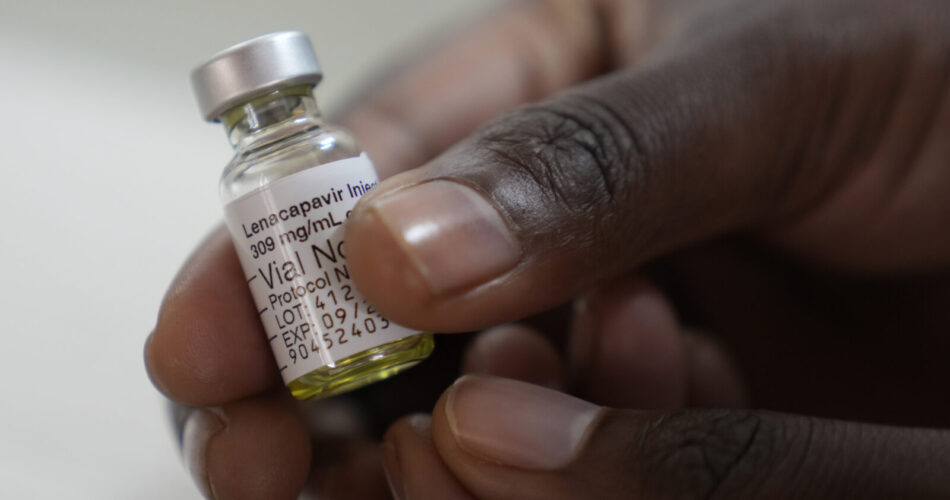
South Africa is being asked to celebrate a success that has not yet happened. Plan to deliver lencapavir (an unprecedented HIV prevention injection) broadly 400,000 Our People's HIV Response has been hailed as a turning point in the country's HIV response. But all the doses donated are not in hand yetThe rollout has not begun on a large scale, and the gap between promise and delivery remains wide.
The government's recent call for expressions of interest to manufacture lencapavir locally under the auspices of the South African National AIDS Council (SANAC) is being framed as a decisive step forward. In fact, this is the beginning of a long and uncertain process that hands immense power to the unsuspecting lencapavir monopoly holder: gilead science.
As per expression of interest, published on 5 March 2026Local manufacturing companies are invited to (re)apply. SANAC will shortlist and evaluate the proposals and then proceed with license negotiations with Gilead. Only if those negotiations with Gilead are directly successful will the license be granted on terms that are not yet defined and not controlled by South Africa. Only after this will production be able to start. Only after that regulatory approval will be sought. opposite of what unitaid Suggested, in fact, this is unlikely to happen within a year (the other 6 licensees are not on the market yet, those licenses were issued some time ago, and not even one is on the market yet, including egyptian).
The HIV epidemic will not respect this deadline. South Africa's record continues Hundreds of new HIV infections Every day. Yet the response being built moves at the pace of committees, approvals, negotiations and conditional agreements. There is no binding timeline for when locally produced doses will reach those who need them most.
- There is no commitment on how many doses will be produced each year.
- There is no clarity on what their price will be.
- There is no clarity on whether patients from outside the state can also access them, and how.
- There is no clarity on whether South Africa will be allowed to supply to countries outside Africa, which Gilead had excluded from previous licensing arrangements.
In an active pandemic, these shortcomings would have real consequences.
Of concern is that the expressions of interest are notably silent on whether SANAC's shortlisting decisions are binding. If, as suggested by insiders, final approval lies with Gilead Sciences, enabling them to veto any shortlisting by SANAC, the process risks reducing national actors into facilitators rather than decision makers.
A manufacturing plan without control
The SANAC expression of interest process makes one thing clear: despite all the promises of multi-stakeholder review and engagement, and all the prematurely celebratory news headlines, the outcome of this initiative is not in South Africa's hands. The looming shadow of Gilead, whose track record prioritizes profits over reach, looms ominously before us.
Local manufacturing does not equal freedom. In this case, it will depend on whether a seventh voluntary license is actually granted, on what terms, and on access to knowledge and inputs that remain controlled elsewhere. At any point in the process there is no enforceable guarantee that local production will actually go ahead, let alone at the required scale.
Subscribe to our newsletter
This arrangement also risks reducing SANAC to an administrative clearinghouse. It convenes meetings, consults and coordinates, but it does not take decisions. The license, if granted, will be issued under terms set by Gilead Sciences, which will retain control over pricing, volume, and speed of scale-up. As a result, the South African government is left to implement a program whose most important parameters are decided elsewhere. That is not a partnership.
South Africa can host factories and assemble the product. It can take the burden of delivery. But without authority over all aspects of licensing, including pricing and scale, it does not control the outcome.
This leads to a strange development in which South Africa prepares to build capacity without knowing whether it will be allowed to make full use of it. It invests in future supply chains that it does not yet rule. It signals ambition while accepting uncertainty at every critical point.
This dynamic has defined the relationship between African countries and global health innovation for decades. The work happens here: testing, data, mobilizing communities, building delivery systems. When a breakthrough emerges, the continent is (perhaps, eventually) invited to participate in its production, but rarely to dictate its terms. We saw this in their local licensing arrangements with pharmaceutical companies during the COVID-19 pandemic, even stipulating the final destination for locally manufactured supplies. Lencapavir is starting to follow the same script.
capacity without guarantee
Local licensing announcements and proposals focus on capacity: infrastructure, compliance and technical readiness. It asks who can produce. The answer is not who will be protected. There is no binding commitment yet on production volumes. There is no indication of how many people will actually receive it each year. There is no target associated with the number required to disrupt transmission. There is no defined price, no limit, no mechanism to ensure that locally produced doses will be affordable at scale or to assure that, in addition to South Africa and the region, other countries bypassed by Gilead will also benefit from South African manufacturing.
Without these elements, manufacturing does not automatically translate into equity or access. It could just as easily reproduce the deficiency under a different label.
The question is not whether the license will be signed or not, but rather what that license actually guarantees and provides. The South African government could have taken mandatory measures, but has so far chosen not to do so. So now the details of the program will be in the hands of Gilead's lawyers, not the Minister of Health, SANAC or even the President.
This is not a new thing. Often, voluntary licensing arrangements presented as successes fail to translate into access. They lack enforceable timelines, guaranteed quantities, real price commitments and meaningful technology transfer. They provide false hope.
A license that transfers production without transferring power makes very little change. The test is simple: Does it reduce infections over the next two years, or postpone them?
South Africa has not answered this question
There is a practical way to read the present moment. Manufacturing takes time, systems have to be built and standards have to be met. All this is true. But practicality has a way of being harsh in acceptance. And in South Africa, a country already struggling with the burden of the disease, a situation worsened by the U.S. government's punitive HIV funding cuts, acceptance comes with a tangible price.
South Africa is doing vital work to make life-saving technology available. But whether that work will result in access to the scale and speed needed to disrupt HIV transmission cannot yet be guaranteed. This is the contradiction at the core of this effort. A country at the center of the HIV epidemic is building a system it does not fully control, that sets no timelines, the results of which it cannot yet secure.
The epidemic does not end like this.
__________________________________________________________________
Tian Johnson is the founder and strategist of the African Alliance, a pan-African health justice advocacy group. Fatima Hassan, is a South African human rights lawyer and social justice activist and founder of the Health Justice Initiative. This is Part 2 of Johnson and Hassan's two-part opinion series examining the gap between scientific success and public health impact in South Africa's response to HIV with the advent of long-acting lencapavir.
The views and opinions expressed in this opinion piece are those of the author, who is not employed by Health-e News. Health-e News is committed to presenting diverse perspectives to enrich the public discussion on health issues.