
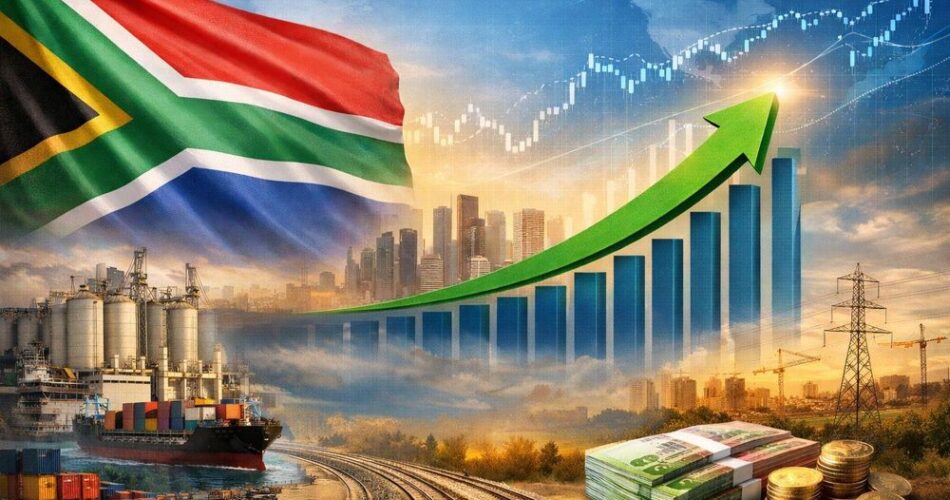
In a promising turn of events for the South African economy, the National Treasury has forecast a gradual acceleration in growth, with growth projected to increase by 0.2 percentage points annually, which will culminate in reaching the target of 2% by 2028.
The optimism comes after a surge in gross domestic product (GDP) that saw the economy expand by about 2.1% in 2022, largely due to the recovery from the impact of the COVID-19 pandemic. business Report.
Achieving similar growth rates by 2022 could provide significant relief to South Africa's notoriously high unemployment rate, which currently stands above 31%.
Finance Minister Enoch Godongwana recently stressed in the national budget review presentation that the domestic growth outlook is improving, driven by a stable global economy amid the backdrop of ongoing geopolitical tensions that are reshaping trade policies and supply chains around the world.
“We forecast real economic growth of 1.6% in 2026, an improvement from the 1.4% projected in 2025,” Godongwana announced.
He attributed this optimistic trajectory to strength in economic performance from the latter half of 2025, and said that in the medium term, average growth is projected to hover around 1.8% before reaching the 2% mark by 2028, Business Report reported.
The Deputy Minister of Finance, David Masondo, echoed this sentiment during a pre-speech media briefing, emphasizing the connection between the improvement in investor confidence, low interest rates and the decline in risk premia with the structural reforms undertaken by the government over the past five to six years.
“These corrective actions have made a significant contribution to stabilizing critical sectors such as power supply, freight, rail, and boosting tourism and simplifying visa applications to attract skilled workers,” he said.
The government is set to make significant investments in infrastructure, with public sector spending expected to exceed R1 trillion over the next three years. However, while global economic resilience remains a promising sign, risks to trade remain. According to Masondo, the focus should now turn towards strengthening domestic growth drivers through accelerated structural reforms.
Globally, growth forecasts indicate a stabilization rate of 3.3% by 2026, mirroring projections for 2025. While advanced economies are projected to grow slower, emerging markets, particularly sub-Saharan Africa and India, are poised for faster growth due to strong domestic demand. Meanwhile, as China moves from an investment-led to a more consumption-driven economic model, changes in global trade dynamics are also anticipated.
However, despite these optimistic projections, Godongwana cautioned that enduring challenges such as persistent logistics bottlenecks, inadequate public infrastructure and outbreaks such as foot-and-mouth disease pose significant risks to domestic economic activity. He reiterated that addressing structural barriers such as high unemployment rates and transportation issues is key to achieving sustained growth.
“Rapid implementation of reforms, especially in energy, water and transportation, is essential to drive the economy forward,” Godongwana said. He further said that a balanced fiscal approach and enhanced public state capacity are fundamental to driving rapid inclusive growth.
As South Africa aims to navigate the complexities of its recovery, officials are adamant that the way forward lies in maintaining macroeconomic stability, engaging in structural reforms and investing in infrastructure that facilitates growth and attracts private investment.
IOL business