
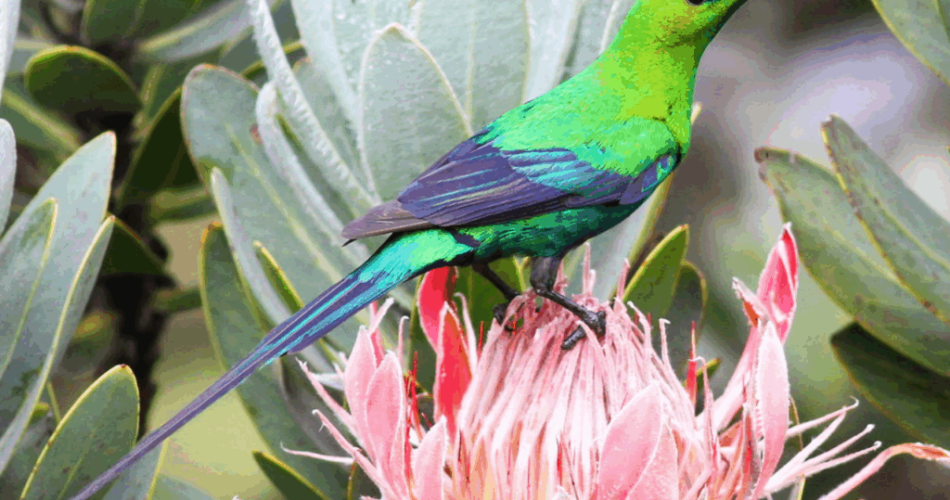
(Image: Wikimedia Commons)
South Africa is one of the most biodiverse countries in the world, making conservation even more important.
However, the biggest obstacle to caring for the planet is the idea that nature belongs somewhere else: the Karoo, the Kruger, a wildlife documentary. It's not like that.
where is nature we live. It is where we raise our families, build our communities and sustain our livelihoods. It's the water in our taps, the food on our tables, the air in our lungs. Home is something we protect at all costs.
Most of the youth also feel the same way. A recent survey of more than 23,000 youth in 44 countries found that 65% of Gen Z and 63% of Millennials were concerned about the environment. And yet only one in five have taken concrete action, such as changing jobs or purchasing sustainable products, due to environmental concerns. The desire is there. The question is, what is standing in the way?
Six myths are causing harm. WWF South Africa reveals the truth behind every one of them
Myth 1: “Conservation has nothing to do with me”
The life you are living completely runs on nature. The water you drink is filtered by wetlands and mountain watersheds. The fruit in your smoothie depends on bees. The cotton in your favorite hoodie requires healthy soil and rainfall. South Africa is one of the most biodiverse countries on Earth, and that biodiversity is the invisible infrastructure holding your daily routine together. When it breaks, your routine also breaks.
do one thing today: Buy local, eat seasonally, waste nothing. Choose fresh and domestic produce over imported and processed. The food system is one of the largest drivers of biodiversity loss on Earth. It's what's in your trolley that matters.
Myth 2: “Conservation is only about animals”
Animals get the headlines, but conservation is really about systems. The healthy fynbos on Cape Town's mountains helps capture the rainfall that fills your taps. Mangroves along the KwaZulu-Natal coast protect coastlines from flooding. Insects you barely notice pollinate about a third of the food you eat.
South Africa is one of only 17 megadiverse countries on Earth, home to approximately 10% of the world's known bird, fish and plant species. Lose plants, fungi, insects, soil bacteria and animals, potentially including us.
do one thing today: Visit sanbi.org and find out which of South Africa's nine biomes you live in. Learn what it does for you that you didn't know.
Myth 3: “Conservation is an empty space. It's not for people like me”
This needs to be said clearly. Historically, patronage in South Africa kept black South Africans out of the land, out of decision making, out of the narrative. That legacy is real, and it matters. But the future of conservation here depends entirely on whether it belongs to all South Africans.
Indigenous knowledge about local plants, animals and ecosystems is irreplaceable. Community-based projects are proving to be more effective and more sustainable than top-down models. The movement needs more voices, more faces, and more lived experiences at the table, including yours.
do one thing today: Find a Black-led conservation voice, project, or community initiative and amplify it. Share work, tag a friend, start a conversation. The more visible and diverse the voices are, the more the movement will change.
Myth 4: “Being green is expensive. It's a privilege I don't have”
The eco-lifestyle industry has done conservation no favors. But living in ways that are less harmful to nature doesn't require a big budget. This often requires smaller. Buying less, buying second-hand, eating less meat a few days a week, fixing things instead of replacing them.
These are not luxury treats. They won't save the planet alone. But they change your relationship with consumption, and consumption is one of the biggest drivers of biodiversity loss on Earth.
do one thing today:Challenge yourself: No new clothes for 90 days. Only second-hand, swapped or borrowed. Use Yaga, your area's charity shop, or swap with friends. Track what you save, share what you find – you'll be surprised how quickly this becomes not a compromise, but a flex.
Myth 5: “South Africa has bigger problems than the environment”
Nature cannot wait and this is no different from problems like unemployment, crime and energy insecurity. When extreme weather destroys crops across the country, it is not the rich whose food security is at risk. When floods wash away informal settlements, it is not the rich who lose everything.
South Africa's economy depends more directly on nature than most: agriculture, fishing, tourism and water security support millions of jobs and billions in GDP. Environmental degradation is not a crisis that occurs after other crises have resolved. This is the crisis beneath all others. You can't build a just society on a broken ecosystem.
do one thing today: Follow an environmental justice organization that is doing work where it matters most, whether it's water rights, climate resilience in informal settlements, or pollution and health. Sign up for their newsletter. When you understand how the environment and inequality are linked in South Africa, you can't ignore it.
Myth 6: “It's already too late”
Globally, almost a third of young people believe that climate change is beyond our control and it is too late to do anything about it. This is an understandable feeling. But this is not supported by evidence.
Species that were declared extinct have been rediscovered. Rivers closed to fishing have recovered beyond expectations. The whale population has increased again. Nature, given half a chance, comes back.
South Africa has one of the most resilient and most fragile ecosystems on the planet. The window is closing, yes. But it has not stopped. This house is still worth saving. Despair is not humility. This is just another way of doing nothing.
do one thing today: Plant something. Anything. A herb on the windowsill matters. Start where you are.
South Africa covers only 2% of the world's land, yet it has an extraordinary concentration of life. It is home to more than 5,000 plant species found nowhere else on Earth, more than 13,000 marine species and the Cape Floral Region, one of only six floral kingdoms in the world.
But according to South Africa's National Biodiversity Assessment 2025, almost half of the country's ecosystems are now at risk, and South Africa is losing ecological resilience at a rate that threatens long-term water security, food systems and economic sustainability. It is clear that we have a lot more to do and bust the myths.
South Africa's natural heritage belongs to all of us. Are we willing to act like this?
(Source: WWF)