
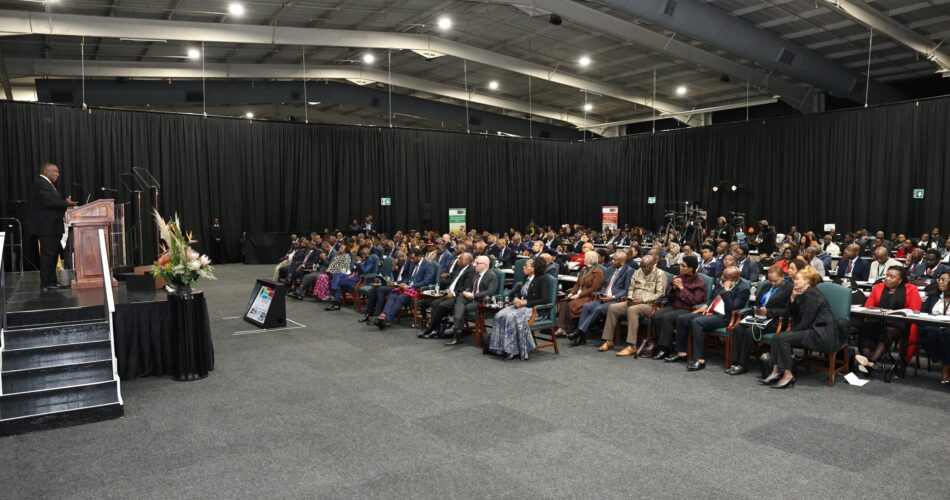
President Cyril Ramaphosa speaks at the South Africa-Kenya Business Forum in Midrand. (DTIC/X)
While Presidents Cyril Ramaphosa and William Ruto talked industrialization, investment and African integration, business leaders from the South Africa-Kenya Business Forum repeatedly returned to a simple complaint: Africa's trade deals are moving faster on paper than at border checkpoints, customs offices and regulatory agencies.
Held at the Gallagher Convention Center in Midrand as part of Ruto's state visit to South Africa, the forum brought together government officials, financiers, industrialists and business organizations from both countries. What emerged was an unusually frank discussion about the barriers that are hindering trade and investment between Africa's two most important economies.
Despite all the enthusiasm over the African Continental Free Trade Area (AfCFTA), speakers argued that the next phase of African integration will depend less on new agreements and more on removing practical barriers that continue to frustrate businesses operating across borders.
This message came repeatedly from officials, investors and business organizations representing both countries.
Kenya and South Africa hold important positions in their respective fields. Kenya is widely considered the gateway to East and Central Africa, while South Africa remains the continent's most industrialized economy and largest financial centre.
Yet trade between the two countries remains modest compared to their economic weight.
Bilateral trade to reach approximately $680 million in 2025. Kenya remains one of South Africa's largest trading partners outside the Southern African Development Community, while more than 60 South African companies operate in Kenya in sectors including banking, insurance, telecommunications, manufacturing and retail.
Ramaphosa says South African companies have launched 96 investment projects in Kenya worth more than $2 billion. Kenyan companies have invested in 11 projects in South Africa worth about $283 million.
These figures set the stage for a forum that focused less on business data than on what would happen next.
Sim Tshabalala, chief executive of Standard Bank Group, argued that Africa's integration challenge remains significant despite the establishment of the AfCFTA.
Describing Kenya and South Africa as “the two segments of Africa's most important North-South economic backbone”, Tshabalala said the East African Community and Southern Africa have the potential to create a powerful economic corridor from Mombasa to Cape Town.
Yet Africa trades very little within itself compared to other regions of the world.
He said Africa's intra-regional trade contribution to exports is about 17%, while in Asia it is 59% and in Europe 69%.
Tshabalala proposed two practical measures that could accelerate integration: a continent-wide customs processing system and visa-free travel for African business leaders.
His comments were echoed by Kenyan industrialist Raghbir Singh Chatte, managing director of Kibos Sugar and Allied Industries, whose group has invested about R3.5bn in South Africa.
Chatte's investments include agricultural operations in Mpumalanga and sugar sector properties in KwaZulu-Natal. He said the investment supported hundreds of South African jobs and demonstrated the benefits of African capital being invested on the continent.
“African capital invested in Africa does much more than generate returns,” he said. “It creates jobs, develops skills, strengthens communities and puts value on our continent where it belongs.”
Chathay argued that African countries need to more effectively facilitate the movement of skills and expertise and move beyond the export of raw materials towards local processing and manufacturing.
The focus on industrialization was highlighted by Dr Stavros Nicolaou, Chairman of Business Unity South Africa.
“Our industrial ambitions on the continent need to be matched with regulatory pace,” Nicolau said.
He pointed to fragmented rules, customs barriers and inconsistent standards as barriers preventing businesses from fully exploiting the opportunities created by the AfCFTA and other regional trade agreements.
Nicolau also highlighted the unequal nature of trade between the two countries. South Africa exported significantly more to Kenya than it imported, reflecting both the size of South Africa's industrial base and the limited diversification of trade flows into Africa.
He argued that the solution lies not in restricting trade but in expanding it through investment, manufacturing and stronger regional value chains.
The strongest call for urgency came from Jas Bedi, president of the Kenya Private Sector Alliance.
Bedi proposed technical working groups, faster customs validation processes and accelerated negotiations on rules of origin. He called on governments to focus on implementation rather than additional commitments.
“AfCFTA is now law but without implementation, law is just words,” he said.
His comments appeared to capture the mood of many participants.
Throughout the day, business leaders returned again and again to the same concerns: customs delays, regulatory duplication, non-tariff barriers and the slow pace of implementation.
What was striking about the forum was that both presidents largely accepted the diagnosis.
Ramaphosa's address reflected many of the issues raised by business.
They talked about the need to address implementation challenges under the AfCFTA, modernize customs systems, harmonize standards, and expand digital infrastructure.
More importantly, he suggested that relations between South Africa and Kenya were developing beyond traditional trade.
“We have moved beyond what we can sell to each other and toward what we can create with each other,” he said.
This phrase captured a recurring theme throughout the forum.
Be it the discussion on pharmaceuticals, automotive manufacturing, agriculture, fintech or logistics, the speakers focused on creating integrated value chains rather than just increasing exports.
Ramaphosa argued that South Africa and Kenya should cooperate in developing industries rather than compete in separate national markets.
“We should not limit ourselves to ‘Made in Kenya’ or ‘Proudly South African’. We need to come together to make pamoja,” he said.
Ruto also noted something similar.
Positioning Kenya as one of the major industrial and financial hubs of East and Central Africa and South Africa on the continent, he said the two countries have complementary strengths that are capable of driving broader African growth.
“We must move beyond traditional trade and deliberately build integrated regional value chains in manufacturing, agriculture, mining, logistics, pharmaceuticals, energy, digital services and green industrialization,” he said.
Ruto repeatedly emphasized industrial policy, infrastructure and value addition.
He pointed to Kenya's strengths in fintech, mobile money, digital services and logistics, highlighting opportunities for collaboration in automotive assembly, mineral beneficiation, agro-processing and green manufacturing.
The Kenyan President also stressed the importance of transport and logistics infrastructure linking Kenya's Mombasa Port and the Lamu Port-South Sudan-Ethiopia Transport Corridor to South Africa's major ports as part of a broader effort to strengthen East-South trade relations across the continent.
Overall, the speeches revealed a wonderful synergy between government and business.
Both sides talked about industrialization, value chains, infrastructure, investments and implementation. Both sides argued that Africa's future development depended on greater economic integration.
The difference was that business leaders were more clear about what was hindering that integration.
Ramaphosa seemed to acknowledge that disappointment in his closing remarks.
He urged officials to reconvene business leaders within two years and measure progress through investment results rather than announcements.
Otherwise, he joked, he and Ruto would simply meet at the airport, exchange greetings and return home without achieving anything.
“I would like to come to Nairobi to hear real commitments for investment,” he said.
After a day of demands for implementation rather than new promises, this was as much a challenge for governments as it was for businesses.
The Forum made no major investment announcements and produced no dramatic breakthroughs. This revealed that there is a growing consensus that the next phase of African integration will be measured not by agreements signed but by factories built, goods moved, capital invested and jobs created.
For South Africa and Kenya, this may be the most important outcome of all.