
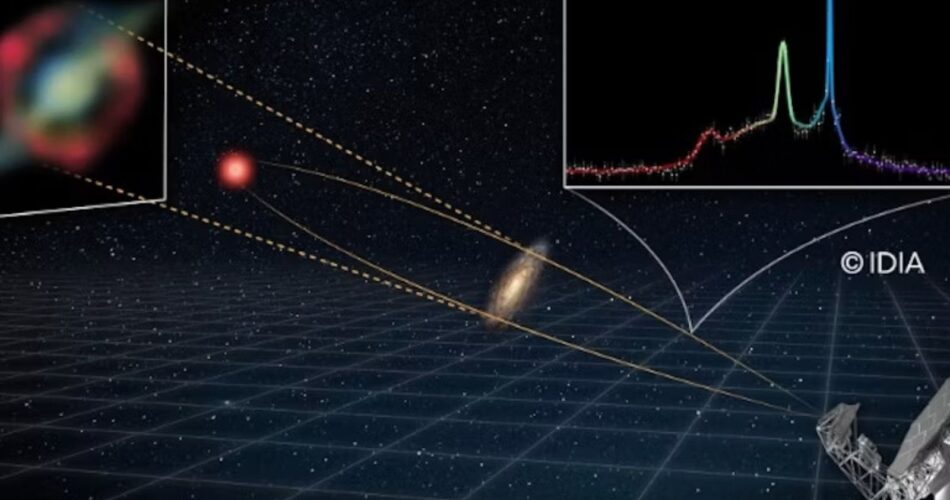
astronomers are using MeerKAT Radio Telescope in South Africa The most distant hydroxyl megamaser ever discovered has been discovered, opening a new frontier in radio astronomy. The Hydroxyl Megamaser is a natural space laser, and it is located in a violently merging galaxy more than 8 billion light years away.
We talked about them to astronomers Thato Manamela, a postdoctoral researcher at the University of Pretoria, and Roger Dean, director of the Inter-University Institute for Data Intensive Astronomy and professor at the Universities of Cape Town and Pretoria. Study.
What you've found has been described as a 'new frontier' in space research. Why is this extraordinary?
This discovery is extraordinary because we discovered it at a record distance of more than eight billion light years. This places it deep in the early universe. This means that we are not seeing the galaxy as it exists today. We are seeing it as it was 8 billion years ago. Since then big bang Occurred about 13.8 billion years ago, we are looking at a “baby” version of the universe. In the phase where the maser signal was transmitted by the host galaxy, the galaxies were much more “chaotic”, collided more often and were much more active than the stable, mature galaxies we see nearby today.
It gives us a rare glimpse of the interactions of galaxies and the extreme star-forming environment when the universe was less than half its current age. Think of light like a letter arriving in the mail. If a friend sends a letter from abroad, by the time you read it, the news is old. In space, light is the letter. It took 8 billion years for the “news” from this galaxy to reach us. We see the galaxy as a “child”, even though, in its time, it has already grown or changed.
We discovered this megamaser, which operates on a power scale millions of times greater than a typical galactic maser. Megamasers and gigamasers are both cosmic radio lasers. While a megamaser is a million times more luminous than a standard maser found in the local universe, a gigamaser is a billion times more luminous, making it 1,000 times more powerful than a megamaser.
In just five hours of observing time we found a signal that would normally require hundreds of hours of observation, given its distance and rarity. But gravitational lensing The signal was amplified enough to detect it. Additionally, when we were targeting neutral hydrogen, the wide bandwidth of MeerKAT enabled the surprising discovery of the megamaser signal in the same data.
This rapid detection suggests that future surveys with MeerKAT and the upcoming SKA observatory could uncover many such distant, extreme objects. Its ability to find it so quickly proves that we finally have the technology to see faint signals from the distant past. It's a preview of what the upcoming Square Kilometer Array (SKA), a unique, one-of-a-kind international mega-project, could achieve.
But a highly complementary next generation feature called Next Generation Very Large Array (ngVLA) It is being planned and designed for manufacturing in the US. The SKA observatories (SKA-Low and SKA-Mid) focus on low-to-mid radio frequencies. NGVLA will operate at much higher frequencies. Together, they will form the two key pillars of next generation global radio astronomy. The discovery gives astronomers a new way to study how galaxies evolved in the early universe.
What technologies or capabilities made this possible?
This discovery was possible due to the sensitivity and wide frequency coverage of the MeerKAT radio telescope. Its ability to detect faint signals over a wide frequency range allows us to search for spectral lines across large cosmic volumes. The spectral line is a cosmic chemical fingerprint. Each atom or molecule emits electromagnetic waves at specific frequencies. Detecting those frequencies tells astronomers what the gas is made of.
In this case, MeerKAT's wide bandwidth allowed us to detect both the hydroxyl line and neutral hydrogen absorption in a single observation. Previously, with older technology, it involved two separate observations.
Equally important are advances in data processing and computing. The data were processed using high-performance computing resources at the Inter-University Institute for Data Intensive Astronomy (IDIA).
Processing such large amounts of data is like trying to drink from a firehose. MeerKAT collects gigabytes of information every second, resulting in files too large for standard computers to handle. To find a signal from 8 billion years ago, which is millions of times lighter than a cell phone signal, we must use robust calibration pipelines. These work like an automated high-tech car wash to remove digital noise and sharpen the telescope's focus. This “cleanup” process requires trillions of mathematical calculations, requiring the use of supercomputers that work for days to convert the raw radio interference into a clear scientific discovery.
Gravitational lensing also played an important role. For example, a massive foreground object, such as a star or galaxy, amplifies the signal from a distant galaxy, effectively acting as a natural telescope and enhancing our ability to detect it.
How does what you've found change our understanding of the universe?
It is rare that a single astrophysical system, a collection of celestial objects, in this case, two galaxies forming a lens system, can change our understanding of the universe. To do this we usually need larger sample sizes. But the combination of recording-breaking distance and search speed was impressive.
This suggests that systematic searches – such as those made by intensive MeerKAT surveys – could transform these rare discoveries into powerful investigations of extreme, yet highly obscure, star formation in the distant universe. As a result of this observation, the SKA observatory and other future telescopes will not look for more similar objects; They will explore the hidden history.
Hydroxyl megamasers are commonly associated with galaxy mergers. We expect some galaxies to host pairs of supermassive black holes from mergers. Almost every large galaxy has a supermassive black hole at its center. When galaxies merge, the supermassive black holes at their centers may eventually spiral toward each other, causing gravitational waves, ripples in space-time. Finding such systems helps astronomers study an important stage in the evolution of galaxies and the environments where these extreme events occur.
By using megamasers to find these pairs, we can study the final stages of how the largest objects in the universe formed. This is a major milestone in the life of the galaxy. By discovering these galaxies now, we are catching them at a key evolutionary stage, the final countdown before they collide and release a huge burst of energy that our next generation of detectors will be able to hear.
The strength of the hydroxyl signal detected by MeerKAT after such a short observation time means that astronomers will be able to detect a large number of these systems over much of cosmic time.
What does this discovery say about South Africa's place in data-intensive radio astronomy?
The discovery highlights South Africa's leading role in radio astronomy. Facilities like MeerKAT, combined with data-intensive platforms like IDIA, provide world-class capabilities for both observation and analysis. It also demonstrates strong local expertise in handling large, complex datasets.
Such discoveries rely on advanced data processing, signal extraction and scientific interpretation. These are all major strengths of the South African research community. As we move from using existing scout telescopes like MeerKAT to building and operating the world's largest radio observatory, SKAO, South Africa is well positioned to remain a center of data-intensive astronomy. Such results reinforce the country's role in shaping the future of the region.
- is a South African Radio Astronomy Observatory (SARAO) Post-Doctoral Researcher, University of Pretoria
- The directors are: Wits Center for Astrophysics; SKA Chair in Radio Astronomy, University of the Witwatersrand
- This article was first published Conversation