
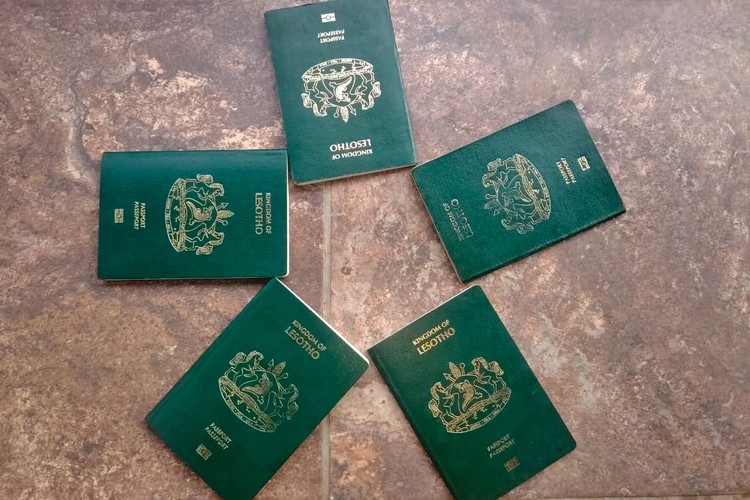
South Africa and Lesotho have agreed that citizens need only their national identity documents to cross the border. Archive photo: Sechaba Mokhethi
- South Africa and Lesotho have agreed that citizens need only their national identity documents to cross the border.
- Children under 16 who do not qualify for a national ID will continue to use a passport.
- Basotho banned from entering South Africa for overstaying will be granted amnesty. They must register with the Lesotho immigration authorities.
- It aims to simplify movement between the two countries and comes in the wake of Lesotho's passport crisis.
Basotho banned from entering South Africa for overstaying will be granted amnesty. The announcement is part of a move towards allowing citizens of both countries to cross the border using their identity cards.
The announcement was made by Lesotho's Home Affairs Minister Labona Lephema after meeting with his South African counterpart Leon Schreiber in Cape Town last week.
The reform, led by a research team formed with officials, is part of a new migration model aimed at simplifying movement between the two countries. It is also being seen as a solution for Lesotho passport crisis.
“We want these processes to start on a clean slate,” said Puleng Mbangmathi, director of legal affairs at Home Affairs. “There are many Basotho who overstayed their welcome and were declared undesirable and banned for a few years.”

Mbangmathi said both countries had agreed to grant amnesty to those affected, provided they register with Lesotho immigration authorities. “These are individuals who simply overstayed their time, not those who committed crimes,” he said. “Their details will be verified with South Africa before they are approved. Affected people are urged to register immediately.”
ID instead of passport
A central feature of the proposed migration model is the introduction of national identity cards as the primary travel document between the two countries.
“We have recommended that the document used by both Basotho and South Africans when crossing the border should be the national identity card,” said immigration manager Bertha Piletso, also a member of the research team.
“In other words, if I am Mosotho, I will use my Lesotho ID to cross the border. Similarly, a South African will use their national ID when crossing between South Africa and Lesotho.”
Currently, travelers have to use passports to cross the border, a process that often results in long queues and administrative delays. The proposed system aims to streamline this through digitization and automation.
Under the new model, passengers will pass through electronic gates. “You'll arrive at the gate, scan your ID and it will automatically open for you to pass through,” he said.
“No travelers will now be processed on the Lesotho side and then on to the South African side,” Piletso said. “Instead, services will be provided at a single point by authorities in both countries.”
Children under 16 who do not qualify for a national ID will continue to use a passport. A passport will also be required for those traveling outside South Africa.
A “unique” migration model
Officials said the reforms are based on research conducted in several countries with support from the International Organization for Migration.
“The main issue is that this team … together with the South African team, met the ministers of both countries and presented their report,” said Puleng Mbangmathi, director of legal affairs at Home Affairs.
Lephema said some measures are expected to be implemented soon, while others will be discussed further at the next Bi-National Commission (BNC) meeting later this year.
He also addressed the issue of Basotho working in South Africa, particularly in low-skilled sectors. The Labor Commissioner, Mamohle Matsoso, said he had been referred to labor authorities in both countries to determine “quotas for Basotho to work in South Africa, as well as the period”.
Matsoso said South Africa has recognized wool shearing as an important skill. “The South African government has acknowledged that this is a skill that does not exist in their country,” he said.
Student Visa and Medical Assistance
Changes for Basotho students may also be in the near future.
“When Basotho students apply for permits to study in South Africa, they are required to provide medical assistance,” said Thato Mapuleng Mokitimi, a legal officer at Lesotho's foreign ministry.
“For a long time, only South African medical insurance has been accepted, which has been a challenge… especially in terms of cost.” He said the two countries have agreed to explore accrediting Lesotho-based medical aid schemes.
Launching the Electronic Travel Authorization (ETA) system was also discussed in the meeting.
“Currently, Mosotho visiting South Africa are given a 90-day quarantine,” Mokitimi said. “Under the ETA system… they will be able to apply for an extension of up to 180 days, provided they show valid reasons.” This, he said, would help reduce overstays, which is a major reason for people being declared undesirable.
Although the announcements mark a significant shift, not all changes will happen immediately.
© 2026 GroundUp. This article is published under GroundUp Reproduction License Version 1.0. email (email protected) To request permission to republish.