
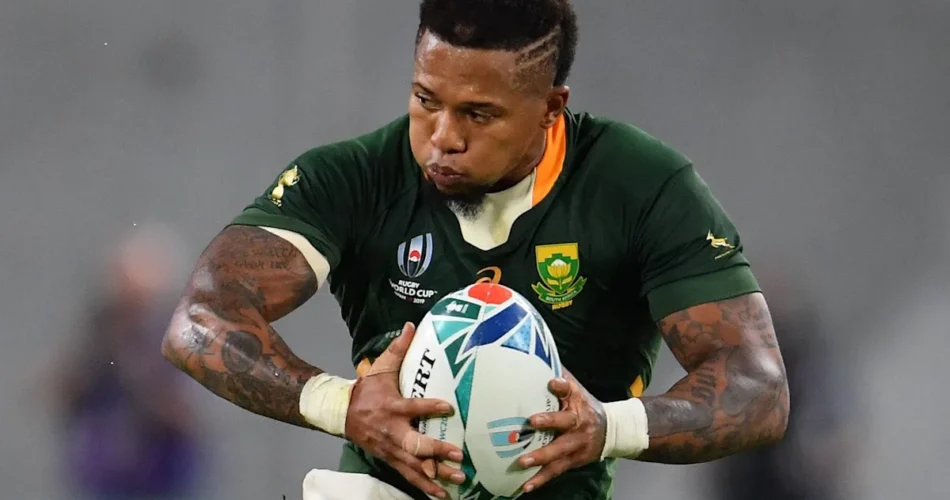
Drug testing on rugby players South Africa There has been a decline of more than six times in the last decade, telegraph sport Can reveal.
The significant decline in testing has coincided with the Springboks becoming the dominant force in test rugby and winning back-to-back World Cups in 2019 and 2023.
Advertisement
South Africa is the country with the most convicted dopers in rugby, with 89 violations at the time, accounting for about 20 percent of the total worldwide.
Those caught up in drug scandals include 2019 World Cup winners S'Busiso Nkosi and Elton Jantjies, who were banned for three and four years respectively in 2024.
Current Springbok Asenathi Ntlabkanye is also facing two doping charges after failing a drugs test last year, with his case due to go to trial late next month. He has not been provisionally suspended and has denied any wrongdoing.
But despite this, there was a significant decline in testing in the country after the Springboks retained the World Cup in 2023.
Advertisement
The number of tests conducted within rugby by the South African Institute for Drug-Free Sport (SADS) is set to drop from 785 in 2015 to just 127 in 2024, according to figures published by the World Anti-Doping Agency (WADA).
Over the same period, the equivalent number of tests conducted by UK Anti-Doping (UKAD) increased by almost 25 per cent from 998 to 1,241.
Failed tests haunt Springboks
Hours after South Africa won their final warm-up match for the 2019 World Cup, former Ireland and British and Irish Lions flanker Stephen Ferris posted a photo on social media. It featured the Springboks squad posing for a photo in what looked like a gym, each taking off their shorts and displaying a body that the Incredible Hulk would be proud of.
The overwhelming reaction on social media was that these bodies must have been obtained through some form of doping.
Advertisement
And those allegations were not completely baseless. Just over a month before the photo was taken, it was revealed that South African winger Apiwe Dyanti had tested positive for an unspecified banned substance during a Springbok training camp.
Dyanthi was the 2018 World Rugby Breakthrough Player of the Year and would have been certain to make the World Cup squad had he not failed the test. He was later banned for four years.
South Africa won that World Cup, Defeated England in the finalBut it was not until years later that the two players in the now infamous photo would fail the test.
On the eve of the 2023 tournament, it emerged that Jantjies had failed a drugs test days after being recalled to South Africa's squad for that year's Rugby Championship. He contested the test unsuccessfully, just like Dyanti, and was ultimately banned for four years.
Elton Jantjies misses the 2023 World Cup after failing a drugs test at that year's Rugby Championship – Ashley Western/Getty Images
It then emerged that Jantjies' World Cup-winning teammate, Nkosi, had failed a World Rugby drugs test in May 2024 and by September, he had admitted doping and was banned for three years.
Advertisement
Last August, the South African Rugby Union confirmed in a statement that prop Ntalbakanye had failed a drugs test while declaring his innocence due to a “non-performance-enhancing substance”. It said the substance “was prescribed by a specialist doctor for medical reasons in early 2025 and was taken with the approval and supervision of a doctor specifically appointed to manage the medical affairs of professional rugby players”.

Asenathi Ntalbakanye has a hearing this month but has not been provisionally suspended – Ashley Vlotman/Getty Images
Ntalbakanye was not provisionally suspended pending a hearing later this month and he played for the Springboks in their 73–0 defeat of Wales in November.
The Dianti, Jantjie and Ntlabakanye tests conducted by SAIDs all failed, which also accounts for the sixfold reduction in the number of tests conducted in South Africa over the past decade.
Advertisement
This raises the question of whether any player could escape recognition when the Springboks are on track to win back-to-back World Cups and Rugby Championships and a Test series against the British and Irish Lions in 2021.
South Africa's doping history
The Springboks are renowned for their intense physicality and ability to dominate opponents. But South African rugby has been plagued by doping scandals since the game became professional.
Even one of the most iconic sporting moments of the 20th century, the Springboks' 1995 World Cup victory, was somewhat tainted four years later when legendary captain François Pienaar admitted in his autobiography that he had taken performance-enhancing stimulants during his country's exile from the Test stage due to apartheid.
Advertisement
By the time Pienaar made his confession, Johan Ackermann – now a leading coach of the game – had become the first South African player to be banned for doping in the professional era after admitting to taking nandrolone to aid his recovery from a knee injury. Upon returning from his suspension, he became part of the Springboks' victorious 2007 World Cup team.

Johan Ackermann becomes the first South African to be banned for doping in the professional era – David Rogers/Getty Images
In 2000, South African prop Cobus Visagie was banned for two years after testing positive for nandrolone, which he claimed came from a contaminated supplement provided by the then South African Rugby Football Union. After appealing against his suspension he was acquitted the following year due to “irregularities in laboratory analytical/testing procedure”.
It would take almost another decade for the country's next drug scandal to erupt – courtesy of a crackdown on doping among those dreaming of becoming the next generation of Springboks.
Advertisement
Craven Week is an annual, week-long schoolboy competition shown live on national television and famous for finding future rugby stars.
In 2010, the event was rocked after three players were banned for failing drugs tests. One was Johan Goosen, who was suspended for three months just four days after being named Craven Week Player of the Year.

Johan Goosen failed a drugs test as a schoolboy but went on to play for South Africa – Sean Botterill/Getty Images
Goosen, who played for the Springboks after the ban, was charged with negligence with allegations that he had unknowingly taken a contaminated supplement.
Over the next 13 years, despite the creation of education programs in schools and a promise by the South African Rugby Union to increase testing of junior players, positive tests continued to occur during Craven Week.
Advertisement
The day after Goosen's 2010 suspension, South Africa – the reigning world champions and Lions series winners – defeated Ireland in an autumn international in Dublin. After the game, two Springboks randomly selected for doping control, Chilliboy Ralepelle and Björn Basson, tested positive for a banned stimulant.
Although Ralepelle and Basson were sent home and temporarily suspended, their positive tests were traced to a supplement that was given to all South African players and the pair escaped reprimand.
Praising the verdict, Ralepelle said: “Finally, the facts have come out, and people can see that we were not guilty and are not doping cheaters.”
Those words came back to haunt Hooker over the next decade, after failing another two tests in 2014 and 2019, and being banned for two and eight years respectively. He continued to maintain his innocence.

Chillboy Rapel made a plea deal after escaping a reprimand in 2010, but later failed two more trials in 2014 and 2019 – Wayne Drott/AP
Rapel's sanctions also included the suspensions of Gerbrandt Grobler in 2015 and Ashley Johnson in 2018. Grobler, who never played for the Springboks but later joined Munster and Gloucester, was penalized after admitting taking steroids to aid his recovery from injury.
Advertisement
Johnson was banned after failing a drugs test during his time with Wasps, with allegations that he had accidentally taken his wife's dietary supplement – a fat-burner called “The Secret”, which had been purchased in South Africa.
All of this was before the Dyanti, Jantjies, Nkosi and Ntlabakanye incidents, and it coincided with a huge decline in testing in South Africa, raising questions about testing levels from school children.
test failures
Ross Tucker, a South Africa-based sports scientist and research consultant for World Rugby, said the decline highlighted telegraph sport was “not good”, he added: “It's a shame because there was a time – 10, 15 years ago – when the South African Institute for Drug-Free Sport was really aggressive with its testing and was on the front foot.”
Advertisement
The WADA data also shows that Sides conducted only 66 tests on rugby players after the Springboks' win over England in the 2019 World Cup final, as well as 99 tests in the 2021 Lions tour year. That was during the coronavirus crisis, which had a major impact on drug-testing worldwide, although in the same period Ucad conducted 817 and 985 trials respectively.
SADS chief executive Khaled Gallant attributed the most recent decline to the March 2024 suspension of Africa's only WADA-accredited anti-doping laboratory, which had its authority to analyze samples completely revoked in May last year due to “an inability to satisfactorily address multiple non-conformities against the international standard for laboratories”.
The Bloemfontein lab was previously sanctioned by WADA between May 2016 and September 2018, which coincided with a two-thirds decline in the number of tests conducted by SAIDs annually from 785 to 266.
The latest repeal has forced Sades to send samples for testing to Doha, Qatar, or Gent, Belgium, increasing its costs at a time when Gallant said its grant from the South African government was “fairly stable.” He said the country's rugby union had only provided an annual ex-gratia payment of 150,000 rand (£6,835) for testing in previous years.
Advertisement
The six-fold reduction in testing between 2015-24 also means rugby has dropped from almost 30 per cent of SAD tests across all sports to just 12 per cent, with Gallant admitting this was “not ideal” and was “down to covering all sporting codes that need to be tested”.
He said he was “implementing a sponsorship revenue strategy in 2026, particularly around testing, to address our shortfall from government funding”.
Sedes declined to disclose the number of tests conducted within rugby in 2025, ahead of the publication of the data by WADA in December, or in its annual report in the autumn.
When asked about telegraph sportSouth Africa head coach Rassie Ersmus said: “I'd like to answer that so you don't think I'm running from a question (but) I haven't seen the data or the actual facts published. I don't know how much testing they do and I wouldn't be able to comment on that.”
Advertisement
South Africa's top players are also subject to drug-testing by World Rugby, which has refused to disclose how many tests it has conducted on such players over the past decade, arguing that it risks compromising its intelligence-based anti-doping activities.
But, according to WADA, World Rugby conducted 2,182 tests worldwide in 2024, the lowest number since 2015 outside the Covid years (2020-21).
A World Rugby spokesperson said: “South African players will be in our testing pool along with several other nations, so we will be testing them throughout the year, including out of competition. Our out-of-competition testing also includes home tours.
“Players will also be tested by us at the Rugby World Cup, European professional club rugby competitions if they play in them and as part of (what was) the autumn international series.
Advertisement
“Lab problems have happened before in South Africa and where we have had those problems in that country or any other country, samples are sent overseas, which is established and acceptable, provided the shipment follows WADA guidelines.”